
Use a pot without a drainage hole as a cover pot: leave the plant in the plastic nursery pot it came in, stand that inside, and take it out to water at the sink. A cover pot that measures 10 cm across inside takes a nursery pot sold as 3 or 3.5 inch; most 4 inch nursery pots are as wide as the inside and will not come out again.
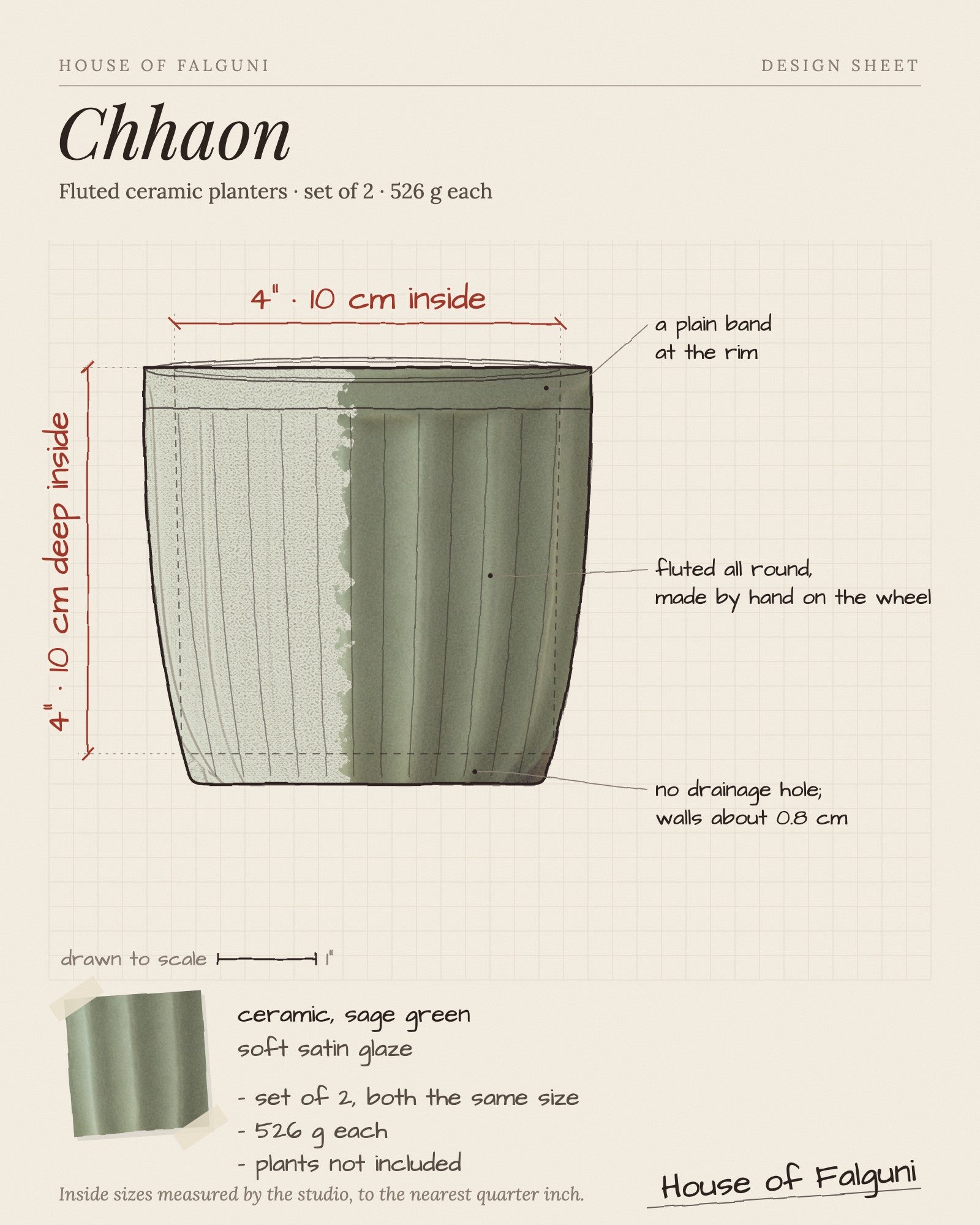
A pot with no hole is not a mistake. Glazed indoor pots are often made that way on purpose, so that nothing drips onto a floor, a desk or a wooden shelf, and the trade name for one is a cachepot, French for "hide the pot". Our Chhaon planters are cover pots of this kind: a pair in sage green ceramic, 10 by 10 cm inside, shaped on the wheel, by hand, in our own Ahmedabad studio. What follows is what we would tell anyone holding one, ours or not.
How a cover pot works
The plant never leaves the pot it came in from the nursery, the black or terracotta plastic one with holes in its base. That inner pot does the draining. The cover pot only holds it upright and hides it.
- Water at the sink. Lift the nursery pot out, water until it runs from the holes, and leave it on the draining rack until the dripping stops.
- Put it back dry. Wipe its base and set it inside again.
- Look in the next day. If water has gathered at the bottom, tip it out. Roots left standing in water for days begin to rot, and a pot with no hole gives no sign that it is happening.
That is the whole method. It takes a minute longer than watering in place, and the plant can move to a sunnier sill, or into a bigger pot, without anyone touching the ceramic.
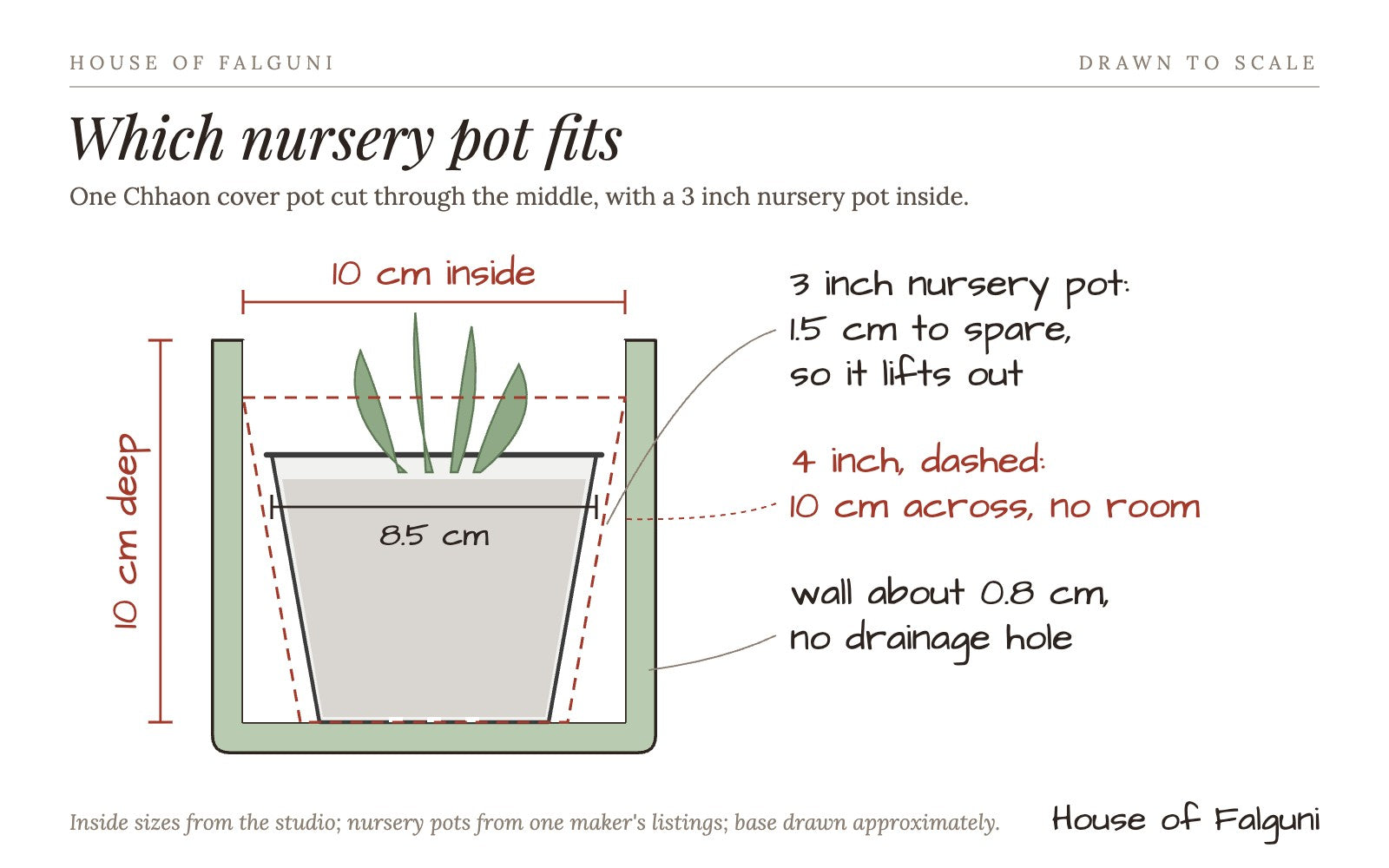
Which nursery pot fits: sizes in cm
Indian nurseries sell plants in plastic pots labelled in inches, and the label is a rough guide to the width at the top. It is not a standard. One New Delhi maker lists a "4 inch" pot that is 3 inches across the top and 4 inches tall, so on that pot the label follows the height. Measure the top of the pot you actually have, rim to rim, and compare it with the inside of the cover pot.
The rule we work to: the nursery pot should be about 1 cm narrower than the inside, so that two fingers can grip it and it lifts out without scraping the glaze. Depth matters less, because a shorter nursery pot simply sits lower.
| Sold as | Top, across | Height | In a cover pot 10 x 10 cm inside |
|---|---|---|---|
| 3 inch | about 8.5 cm | about 7 cm | Fits, with 1.5 cm to spare |
| 3.5 inch | about 9 cm | about 7.5 cm | Fits, just: about 1 cm to spare |
| 4 inch | 10 to 10.2 cm | 8.5 to 9 cm | No: as wide as the inside |
| 5 inch | about 14 cm | about 12.5 cm | No |
Round plastic nursery pots, sizes as printed on Indian sellers' listings on 15 November 2026 (Chhajed Agri Plastic, Greenman Garden Agro Center, Bhoomi Garden Centre and one IndiaMART seller). The last column is worked out from those figures. Labels vary by maker, so measure yours.
The trap is the 4 inch. A cover pot described as 4 by 4 inches sounds made for a 4 inch nursery pot, but one figure is the inside of the ceramic and the other is the outside of the plastic, and both come to about 10 cm. The 3 inch is the comfortable fit; the 3.5 inch goes in with a finger's width to spare.
Square nursery pots need more room than their label suggests. A square pot 7.5 cm along each side measures about 10.6 cm from corner to corner, so it will not drop into a round opening of 10 cm.
If the nursery pot sits low, a few pebbles under it bring the plant up towards the rim and keep its base out of whatever water runs through. The pebbles lift; they do not drain, so the tipping out still matters.
Plants that manage in a cover pot
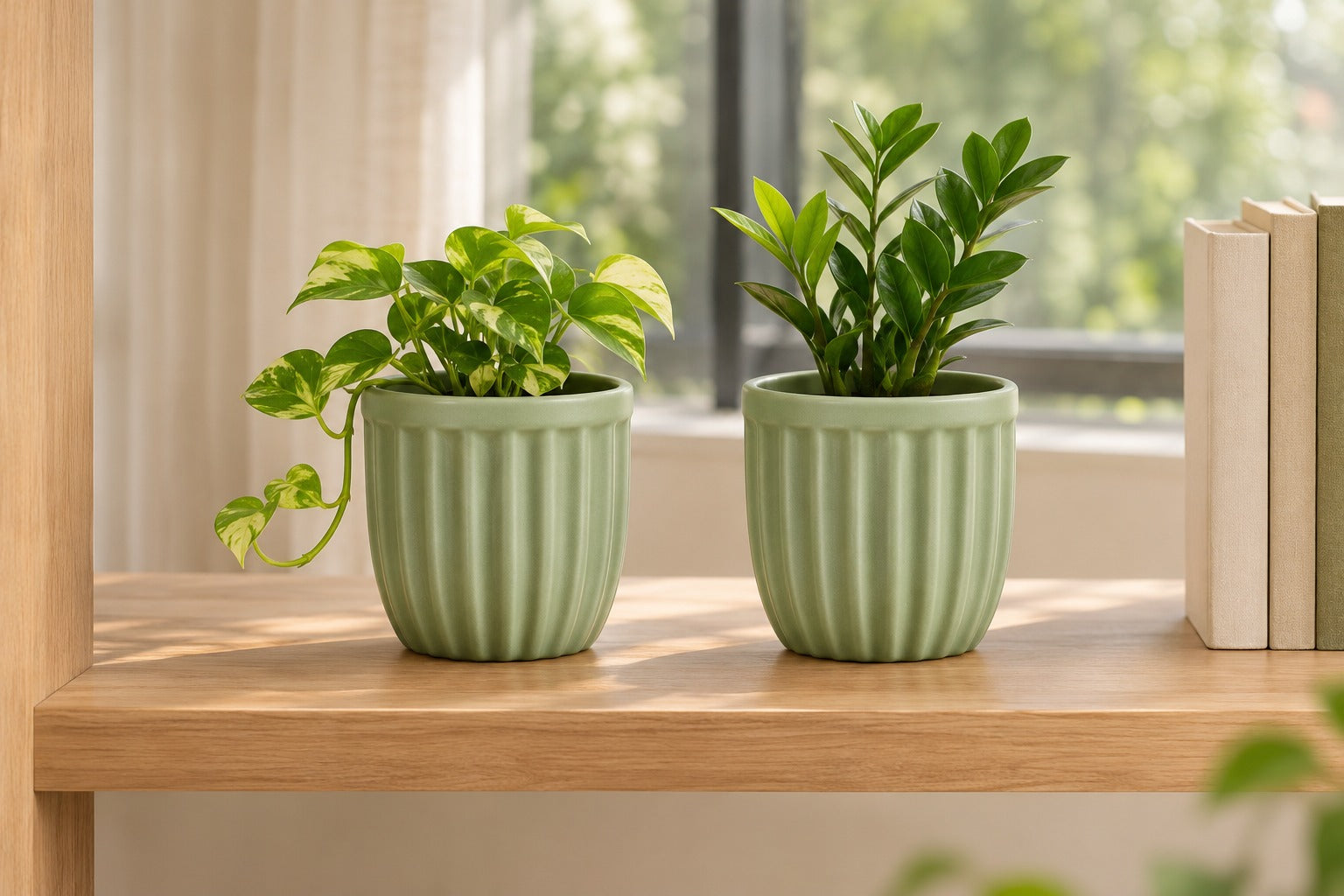
The plants that do well this way forgive a little extra water and do not ask for full sun, which is also what most Indian flats can offer once you are a few steps from the window.
- Money plant (pothos). Grows in low to bright indirect light. Let the top of the soil dry before the next watering; too much water rots its roots.
- Snake plant. Puts up with low light and long dry spells. Overwatering is the usual way people lose one.
- ZZ plant. Stores water in thick underground stems, so it shrugs off dim corners and a missed week.
- Peace lily. Grows in low light and droops visibly when thirsty, which makes it easy to read. It flowers more in brighter light.
- Syngonium (arrowhead plant). Prefers medium, indirect light: a bookshelf near a window rather than a dark corner.
- Aglaonema. Among the most tolerant of low light, and it dislikes cold, so keep it out of the direct blast of an air conditioner.
Whichever you choose, buy it in a 3 or 3.5 inch nursery pot, or ask the nursery to move it into one before you carry it home.
Plants that need real drainage
Succulents and cacti want a bright sill, gritty soil and water that leaves fast. They can sit inside a cover pot only if they stay in a plastic pot of their own with holes, on the brightest window you have, watered when the soil is fully dry and emptied out afterwards. Set directly in hole-less ceramic, they usually rot.
Kitchen herbs such as mint, coriander and basil need several hours of direct sun and quick drainage; on a sunny kitchen sill they can live in their nursery pot inside a cover pot, never planted straight in. Tulsi grows into a small shrub and wants full sun, so it belongs on the balcony in its own pot with a hole.
Can you plant straight into a pot with no hole?
You can, and some people do, but the margin for error is small. Water the soil does not hold has nowhere to go, so it collects at the bottom around the roots. A layer of pebbles under the soil lifts the roots above that water for a while; it does not drain it away. If you plant directly, water a little at a time and choose from the first list, not the second. The nursery pot inside is still the safer way.
Through the Indian year
In the monsoon, soil stays wet for longer, so stretch the gaps between waterings and look into the cover pot more often. In an air-conditioned room the soil dries faster, but cold air blowing straight onto leaves is hard on them, so keep the pot out of its path. In a North Indian winter most indoor plants slow down and want water less often than they did in October.
Frequently asked questions
Can a money plant live in a planter without a drainage hole?
Yes, left in its plastic pot within the cover pot and lifted out to be watered. Planted directly in the ceramic it is easy to overwater, and wet roots rot.
What size nursery pot fits a 10 cm planter?
A 3 inch nursery pot, about 8.5 cm across the top, fits with room to spare, and a 3.5 inch pot of about 9 cm just fits. A 4 inch nursery pot usually measures 10 cm at the top, the same as the inside, so it will not lift out.
Do pebbles at the bottom of a pot help drainage?
Not in a pot without a hole. They raise the roots above the water that collects, but the water stays inside until you tip it out.
Can I keep succulents in a pot with no drainage hole?
Yes, as long as each keeps the plastic pot it was sold in, holes and all, sits on a bright sill, and gets water only when its soil is dry, with anything in the cover pot emptied. Without that inner pot, succulents usually rot.
What is the difference between a cover pot and a planter?
A planter is any pot a plant grows in. A cover pot, or cachepot, has no hole and holds a plant that keeps its own nursery pot; most glazed indoor pots without holes are meant to be used this way.
How often should I empty a cover pot?
Check the day after each watering. If the nursery pot drained at the sink, there is little to tip out; anything still standing at the bottom after a day should go.
Our Chhaon cover pots come as a pair at ₹1,699, in our home collection. Giving one with a plant? Our housewarming gifts guide covers how to hand a plant over in its pot.

