
The old city's square sells vegetables at dawn, gold and silver through the day and dinner after nine. An essay on one piece of ground that changes its trade, and the saint it is named for.
Ahmedabad is good at using the same ground twice. A pol courtyard is a passage for most of the year and a garba floor for nine nights in autumn. A terrace that holds the washing all year becomes a kite field in January. Manek Chowk, in the old city, does it three times a day, and it does it with trade.
Morning, noon and after nine
In the early hours the square is a produce market, with farmers, vegetable sellers and flower sellers. Through the day it belongs to jewellers and bullion traders dealing in gold, silver and stones; the city's own heritage listing describes it first as a gold and silver market. When the jewellers close in the evening, the food stalls take over, setting up from around half past eight, and the square feeds people until well past midnight.
The night market is younger than it feels. It began in the 1970s, when a few vendors sold pav bhaji and dosas to people coming out of late cinema shows. Ice-cream carts followed, and by the 1980s the stalls were licensed. Nearly all of what is cooked there is vegetarian: pav bhaji, dosas, sandwiches, kulfi.
The saint who unpicked the walls
The square is named for Maneknath, a saint said to have lived here when Ahmed Shah I was founding the city in 1411. The story most often told is about cloth. As the walls of the new fort went up by day, the saint sat weaving a mat; at night he unpicked it, and the day's walls came down with it. The endings differ: in some versions there is a contest, in others the saint helps choose where the fort should begin. The city's heritage department records that the square was named after him, and a bastion of Bhadra Fort, Manek Burj, carries his name as well.
For a house that works in cloth, it is hard not to like a city whose founding story turns on a weaver. Things made by hand can be undone by hand, and made again in the morning.
What stays around it
The buildings around the square have kept their places for centuries while the trade in front of them changes. Above the entrance to Badshah no Hajiro, the tombs of the sultan and his family, musicians have played the nagara and shehnai from the naubat khana for about six hundred years, by the heritage department's count. The lane to Rani no Hajiro, the queens' tombs, is now a market for women's clothes, jewellery and garba wear. The Ahmedabad Stock Exchange, founded in 1894, traded from a building on the square until 1996.
Even the night market can pause. In 2025 it closed for about a month while the city laid a new drainage line beneath it, and it reopened that April.
What a wrist carries
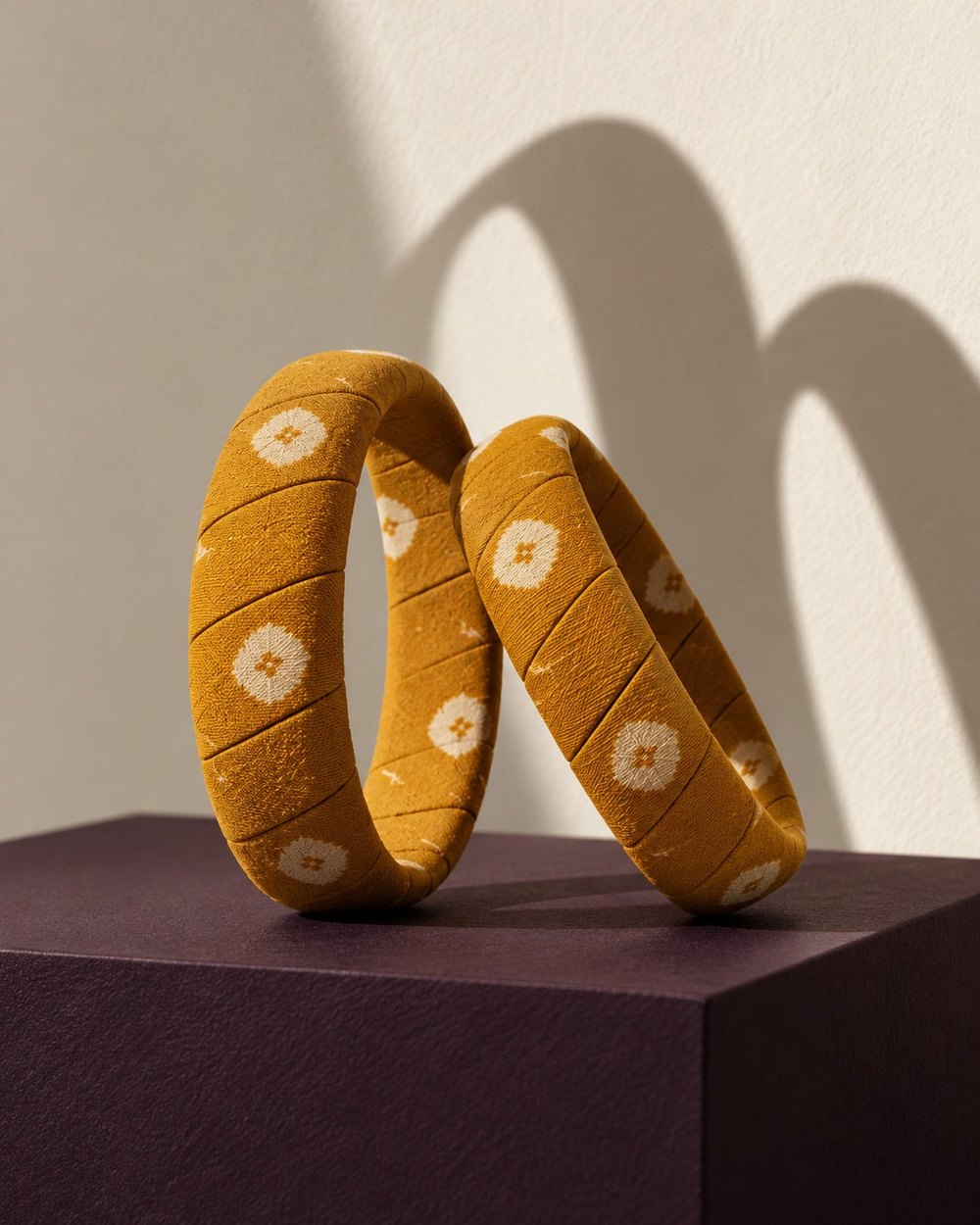
For a house that makes bangles, the daytime trade is the part of the square closest to our own work. Whatever a bangle is made of, gold from a jeweller's counter or printed cotton wrapped over a base, its size is settled the same way: the hand is folded, thumb towards the little finger, and the ring has to pass over the knuckles. Indian sizes are read across the inside of the ring in sixteenths of an inch, so a 2.4 is two and four-sixteenths inches across. A jeweller's eye and a printed chart are doing the same arithmetic.
After nine, the jewellers' counters are shut and the same ground is set with tables. The tombs and the old exchange stay where they have always been; the trade on the ground in front of them turns over every few hours. Perhaps that is why the square has lasted. A place that changes its trade three times a day has had a great deal of practice at changing.
The illustration in this essay was created with AI for Passage and depicts an imagined scene, not a documented view of the square or of any person in it. The essay draws on the city's heritage records, newspaper reporting and published food guides, listed in our notes, rather than a single night's reporting. The product photograph shows House of Falguni bangles.


