
Bamboo is a grass that India's forest law called a tree until 2017. On the culm, the waiting, the split along the grain, and the slow work of turning one stem into something you can eat with.
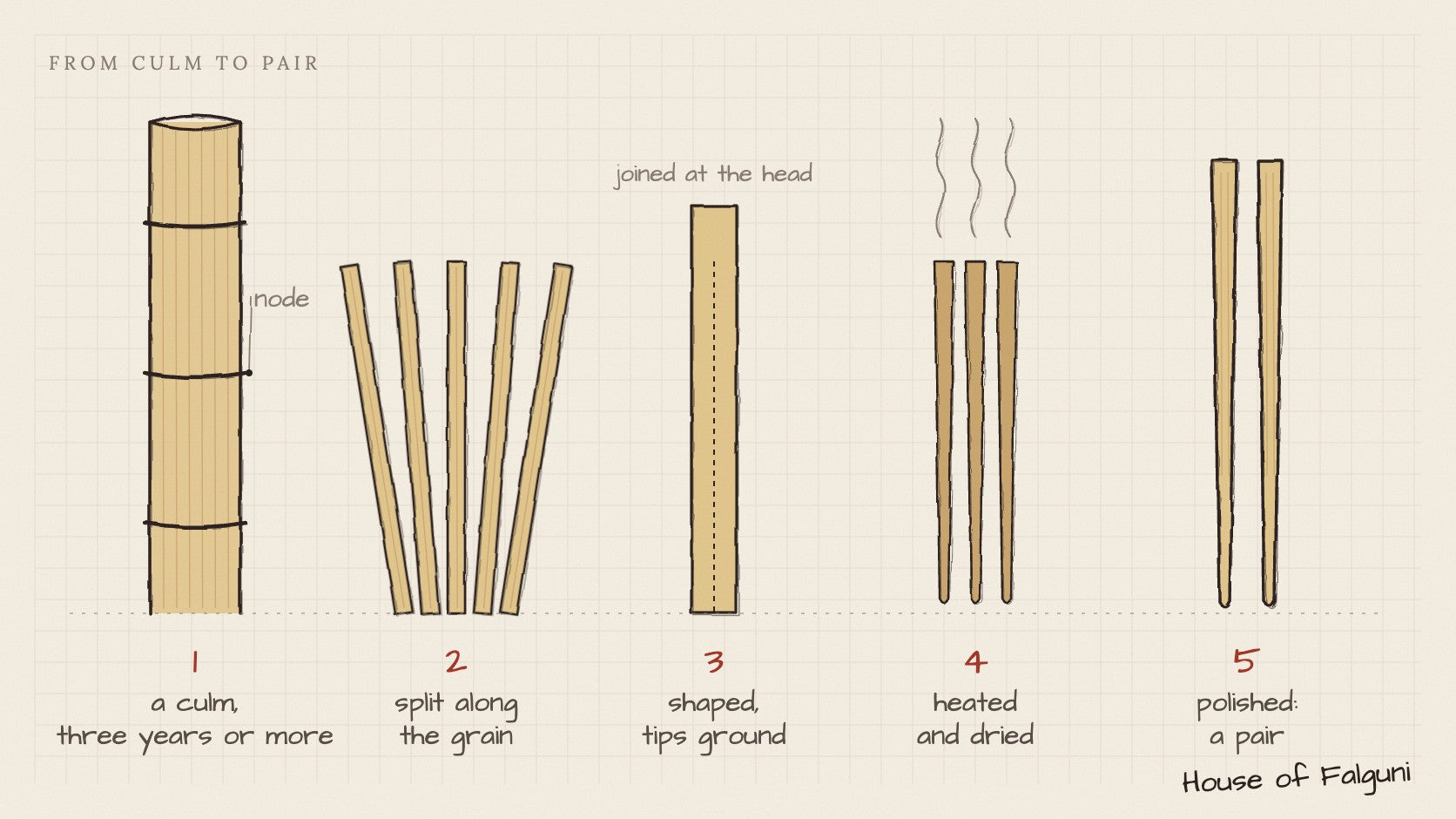
A bamboo culm does its growing quickly and its strengthening slowly. It comes out of the ground at its full width and reaches its full height in a single season of three to four months; some species have been measured at 91 centimetres in a day. Then, for two years or more, the wall of that hollow stem hardens. Nobody makes a good chopstick from a young culm. The factory accounts and the manufacturing patent we read for this essay begin the same way: wait at least three years.
A grass, on paper and off it
Botanically, bamboo has never been a tree. It belongs to the grass family, Poaceae, in a subfamily of its own. In India, though, the Indian Forest Act of 1927 listed bamboos in its definition of a tree, and for ninety years that meant a permit to fell bamboo and another to move it, even when it grew on a farmer's own land. That changed on 23 November 2017, when an ordinance, later passed by Parliament as an amendment to the Act, struck the word "bamboos" out of the definition. Bamboo grown outside forests became, in law, what it had always been in the field: a crop. Bamboo inside forests is still governed by the old Act.
The change was watched most closely in the Northeast. By the figures the government gave the Lok Sabha in 2019, the northeastern states hold about a third of India's bamboo-bearing area, and ThePrint, reporting on the amendment in January 2018, put the region's share of the country's bamboo stock at two-thirds. India as a whole has about 1,49,443 square kilometres of bamboo-bearing land, by the 2021 State of Forest Report, and around 136 species, second only to China in its reserves. Yet in 2016–17 it was importing bamboo for agarbatti sticks from Vietnam, China and Indonesia. The National Bamboo Mission, restructured by the Union Cabinet in April 2018 with an outlay of ₹1,290 crore, set out to close that gap by paying attention to everything after the harvest: treatment, product development and the small enterprises that do the making.
Split along the grain
A chopstick is cut from the wall of the culm, because there is nothing else to cut it from: between the nodes, the stem is hollow. The strength sits in that wall, in bundles of fibre that run along its length and are scattered through it rather than laid down in rings like a tree's, which is why every account of the process splits the culm lengthwise. Some of those walls are remarkably strong: Bambusa tulda, a bamboo of Bangladesh and the adjoining parts of India, has tested as high as 400 megapascals in tension.
What happens between the culm and the pair varies from one workshop to the next, but the order rarely does. Factory accounts, and a 2016 Chinese patent for a bamboo chopstick process, describe the same sequence.
The culm is sawn into sections, usually between the nodes, the ridged joints where the hollow stem closes off. Each section is split lengthwise along the grain into strips, and the green outer skin and the inner layer are taken away. The strips are cut into rough sticks. In one manufacturer's account, a shaping machine carves two sticks at a time, leaving them joined at the top, and grinders shape the tips and cut a clean line at the head. The same account says its premium, knot-free sticks are still split by hand, with the skin and the inner node removed before shaping.
Then comes heat. The patent steams its chopsticks in a closed vessel at 130°C for an hour and a half, a step it calls carbonisation, before drying and sterilising them at close to 100°C. Steaming of this kind is also how bamboo flooring is darkened: carbonised bamboo turns a colour closer to oak, while natural bamboo stays nearer the pale of beech. Whatever the method, the sticks are dried until little moisture is left, below 10 per cent in one manufacturer's account, because damp bamboo grows mould. Last, they are polished, for an hour or more in the patent's polishing machine, to take off the splinters and loose fibres that every split leaves behind.
Why bamboo, and not something shinier
Chopsticks were not always bamboo. The oldest found so far are six bronze sticks, about 26 centimetres long, from the Ruins of Yin near Anyang in China, dated to around 1200 BCE, and they were most likely used for cooking rather than eating. They became eating tools during the Han dynasty, as more rice was eaten. But the language remembers what they were usually made of. In Chinese, both the old word for chopsticks, 箸 (zhù), and the word that replaced it, 筷 (kuài), are written under the bamboo radical, 竹.
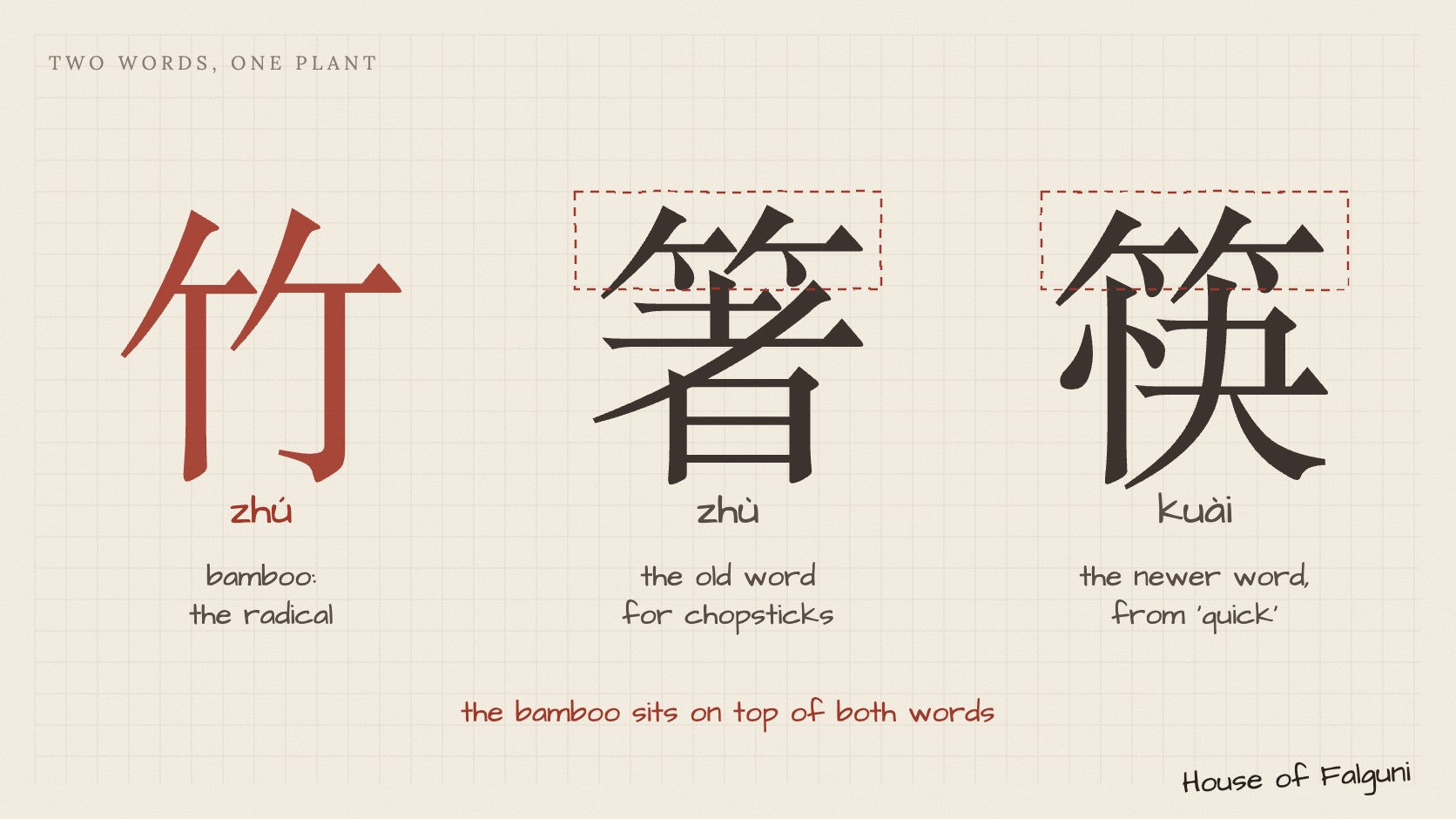
The replacement has its own small story. A fifteenth-century miscellany by the Ming scholar Lu Rong records that boatmen avoided the word zhù, because it sounded like the word for stopping, and a boat on the water should not stop. They called chopsticks "quick ones" instead. The new name kept the bamboo above it.
The practical case is simpler. Bamboo and wood are inexpensive, they carry little heat from a hot bowl to the fingers, and their surface grips food in a way polished metal does not. The same reference that lists those virtues lists the cost: bamboo that is neither varnished nor lacquered can warp and wear with use. Most eating chopsticks fall between 23 and 26 centimetres, long enough to reach across a bowl and short enough to hold near the head.
What we can say about ours
Our own pair, Bamboo Ritual, is made in India by an artisan we work with and checked in our studio before it ships. That is the full extent of what we will claim about how it was made. We are not going to borrow a patent's steps, or the Northeast's story, and present them as ours.
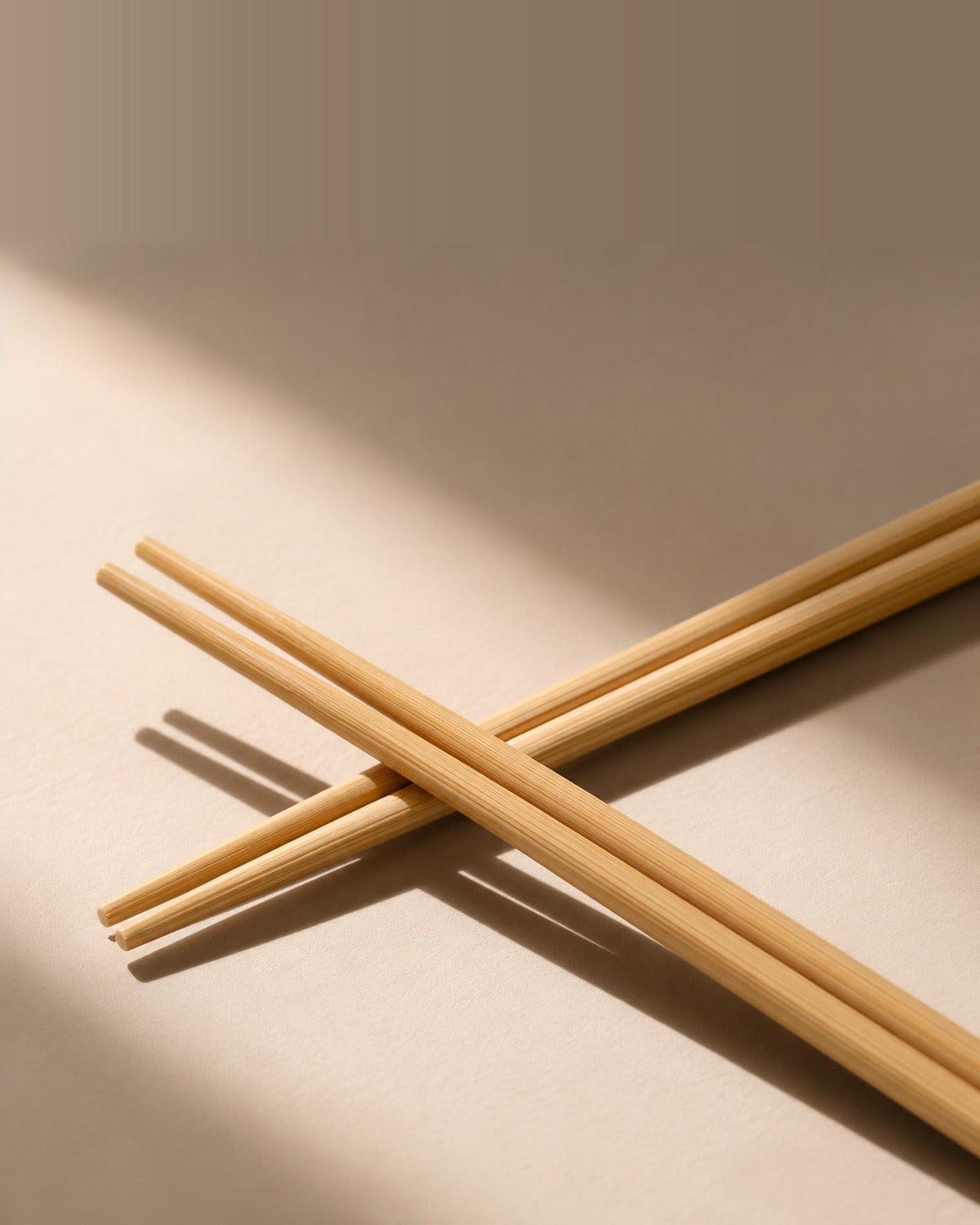
What we can describe is what you will hold. Two pairs, plain, in the bamboo's own colour, with no paint and no print, each stick about 24 centimetres long, inside the usual range for eating. Because they are not lacquered, they ask for what any plain bamboo asks for: a wash by hand, a dry with a cloth straight away, and no long soak. In Light as a Razai we wrote about a quilt whose lightness is made, not found. A bamboo chopstick is the same kind of object: most of its quality is decided before anyone eats with it.
A season to grow, three years to wait
It is a long way from a culm on a hillside to a pair beside a plate: years of hardening, a split along the grain, hours of heat, an hour of polishing. All of that for something that weighs a few grams and is picked up without a thought. A grass that reached its full height in one season, and then waited to be useful.
This essay draws on published histories, Indian government records, a parliamentary reply, a Chinese manufacturing patent and factory accounts, listed in our notes, rather than on a visit to a workshop. The illustrations were drawn for Passage. The product photograph shows House of Falguni's Bamboo Ritual chopsticks.


