
How chopsticks came to India: to the banks of the Hooghly with a sugar planter in 1778, into the lanes of Tiretta Bazaar, and out to Tangra, Kolkata's Chinatown. The food went everywhere. The pair, mostly, stayed with the people who brought it.
Order Chinese food almost anywhere in India and it tends to come with a spoon and a fork. The writer Rohit Jayakaran put it plainly in 2012: we eat biryani and pulao with our hands, he wrote, yet even at a stall running out of the back of an old van, fried rice arrives with cutlery. Indian-Chinese food, which most accounts trace to Kolkata, has reached every high street in the country. The pair of sticks it was first eaten with travelled a much shorter way, and its story is older than the food's.
A sugar mill on the river
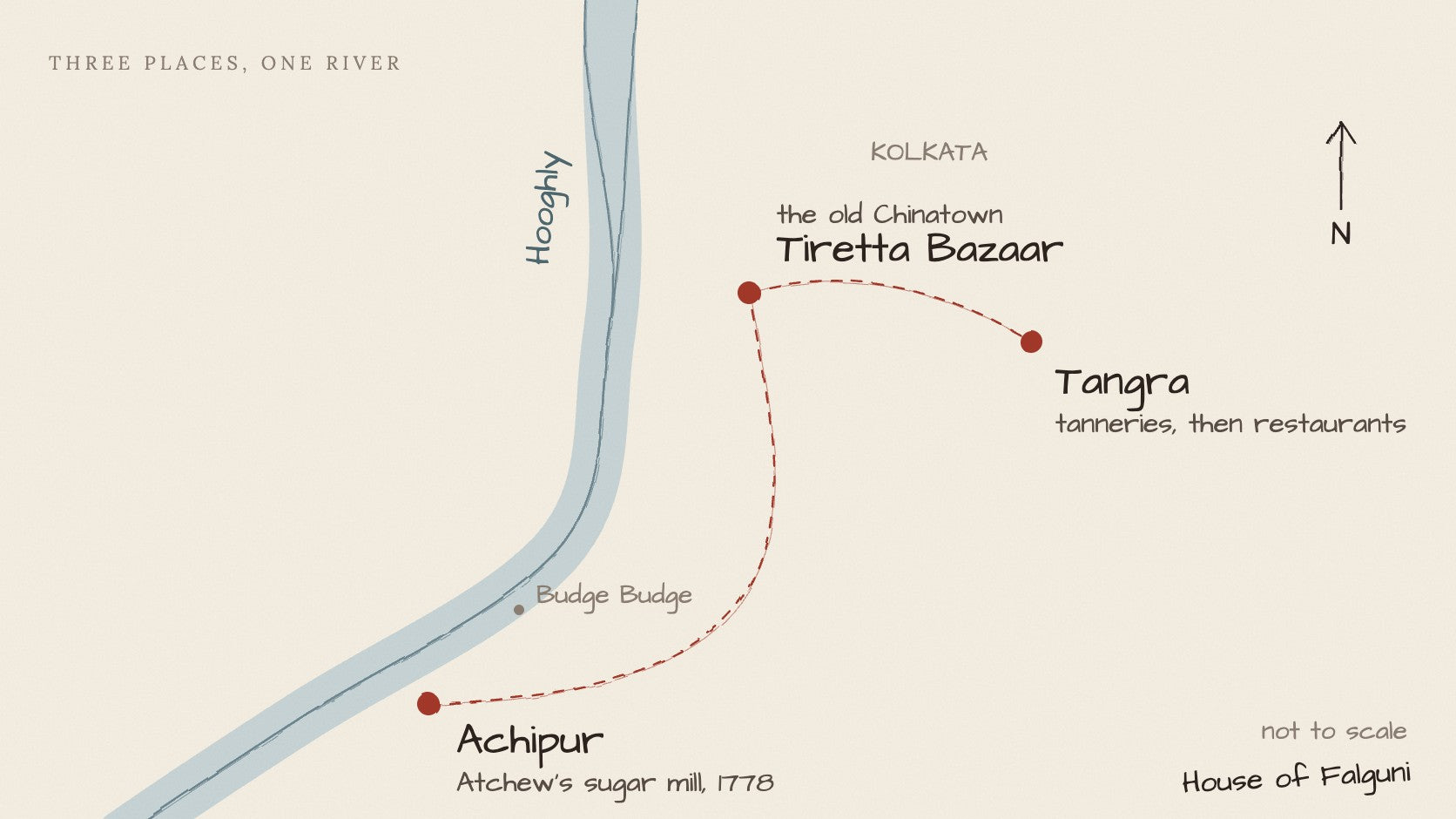
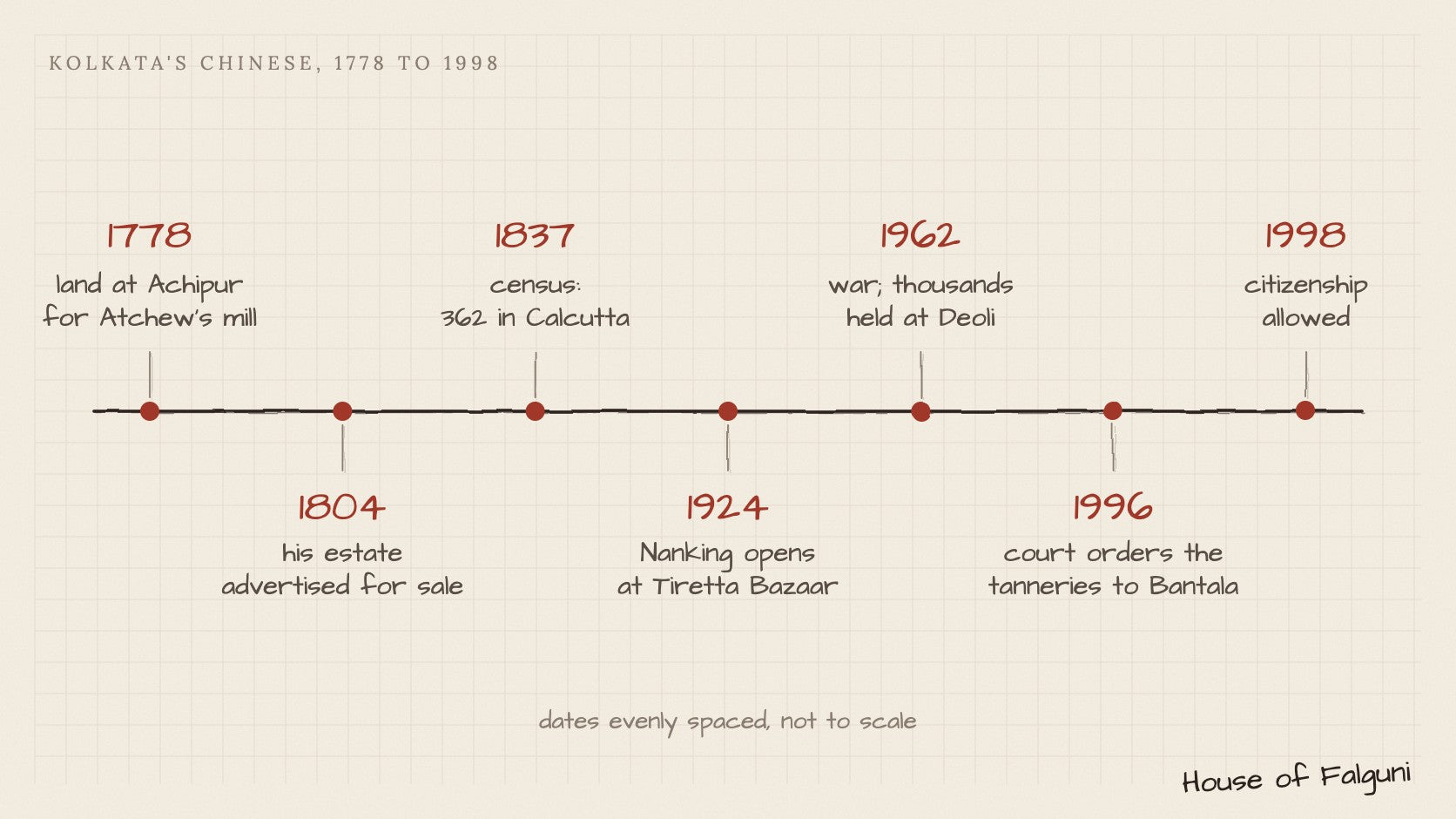
The first Chinese settler in Bengal on record is a trader the British called Tong Atchew; historians give his name as Yang Dazhao. Around 1778, by the East India Company's records, Governor-General Warren Hastings granted him 650 bighas of land on the Hooghly, south of Budge Budge, for a rent of 45 rupees a year. The historian Tansen Sen has said the grant was Hastings' thanks for a consignment of tea. Atchew built a sugar mill and brought indentured labourers from China to work it. In 1781 he petitioned the Governor-General, complaining that Chinese sailors who had deserted their ships were luring his workers away. By 1783 he was dead, and in November 1804 the Calcutta Gazette advertised his estate, with its buildings, stills and sugar mills, for sale.
Locals called him Achi, and the village kept the name: Achipur. Nothing of the mill survives. His tomb does, a red, horseshoe-shaped grave on the riverbank, and so does a small temple to the Earth God and Goddess, whose idols are believed to have come with him from China; behind it stands a smaller Hindu shrine, which some accounts say is dedicated to Dakshin Ray. Every year after the Lunar New Year, families from Kolkata's Chinese community make the trip, about 30 kilometres south-west of the city by road, to pray, burn incense and folded paper, and lay out food, which the families share afterwards. Some come from as far as Canada and the United States, and for a few weeks after the New Year the village takes on the air of a fair. Of all the tables in this story, it is the oldest still being set.
Into the city: Tiretta Bazaar
After Atchew's death, the settlement moved north into Calcutta, to the streets around a bazaar named after Edoardo Tiretta, a Venetian who owned land there in the late eighteenth century. An 1820 treatise, one of the earliest records of Chinese settlement in India, suggests the first arrivals were Hakka. A police census of 1837 counted 362 Chinese in the city, all of them men. More came through the nineteenth century and into the twentieth, many from what is now Guangdong, and the records place them in trades the city needed: Cantonese carpenters around Bowbazar by 1849, shoemakers, tanners, and, much later, dentists.
The first Chinese restaurants opened to feed those workers. Nanking, opened in 1924 by the Au family on the ground floor of the Toong On Church, a Chinese temple, is usually described as the city's first. Eau Chew, opened by the Hong family in 1927, was still being run by a grandson, the chef Joel Hong, when Vice visited in 2017. Pou Chong, a sauce maker founded in 1958 by Lee Shih Chuan, is credited with the green chilli sauce that goes on the city's chow mein. Early on Sunday mornings, the old quarter still holds its Chinese breakfast: stalls selling pork balls in soup, steamed buns and the makings of siu mai, to Chinese families and to plenty of others who have heard about it.
Tangra, the second Chinatown
In the early 1900s, many Hakka families moved east, to Tangra, and set up tanneries; the first Chinese-owned tanneries in the city appeared around the First World War. Some families turned old tannery buildings into restaurants, and by 2017 Vice was calling Tangra the new centre of Indian-Chinese cooking; the largest restaurant, Big Boss, seats more than 500 people. The tanneries themselves were ordered out: a Supreme Court order of December 1996 directed the tanneries of Tangra, Tiljala, Topsia and Pagla Danga to move to a new leather complex at Bantala.
Tangra also has a Kali temple, on Matheswartala Road, where the prasad is noodles and chop suey, offered to the goddess and then given to everyone who comes. The accounts of how the temple began do not agree, and neither do the ages given for it. By one account, Bengali and Chinese neighbours built it together.
1962, and after
The community's numbers tell the hardest part of the story. There were about 20,000 Chinese in Calcutta before the war with China in 1962. Under the Defence of India Act passed that December, thousands of people of Chinese origin were detained, many of them at a camp in Deoli, in Rajasthan. Some were deported in 1964; the last internees were released in 1967. Until the mid-1990s, those in Calcutta needed a permit to travel more than a few kilometres from home. Ethnic Chinese were allowed to become naturalised Indian citizens in 1998. By 2013 the community was put at about 2,000.
The food travelled; the pair mostly stayed
Indian-Chinese food left Kolkata long before the community grew small, and it changed almost from the start. Joel Hong of Eau Chew told Vice in 2017 that Indians "refused to eat bland food", and the cooks answered with chilli and Indian spices; his family says his grandfather invented Schezwan sauce. Chicken Manchurian is usually credited to Nelson Wang, who was born in Calcutta in 1950 and cooked in Bombay in the 1970s. By the time this food reached a van at the roadside, it was being eaten the way India eats most things it does not eat with its hands: with a spoon.
The momo took a different road. Both Tibet and Nepal claim it, and two routes into India are usually given: Tibetans settling in Darjeeling, Sikkim and beyond from the 1960s, and Newar merchants coming down from Kathmandu. Either way, it arrived as a food for the hand. In Kathmandu, the Washington Post's Andrea Sachs wrote in 2019, proper momo etiquette means digging in with your fingers. In Nepal, as in Laos, Myanmar and Thailand, chopsticks are generally kept for noodles.
Where the pair still sits
So the pair's own map in India is short. It runs from a grave on the Hooghly to the breakfast stalls of Tiretta Bazaar and the restaurant lanes of Tangra, and from there into the kitchens of anyone who learned to use it at a Chinese table and kept a pair at home. In The Same Plate, Arranged Differently we wrote that a thali is a region remembering itself out loud. A pair of chopsticks in Kolkata does something similar, more quietly, for a community that has been in the city for close to two and a half centuries.
Once a year, after the Lunar New Year, that table is set again by the river where it began.
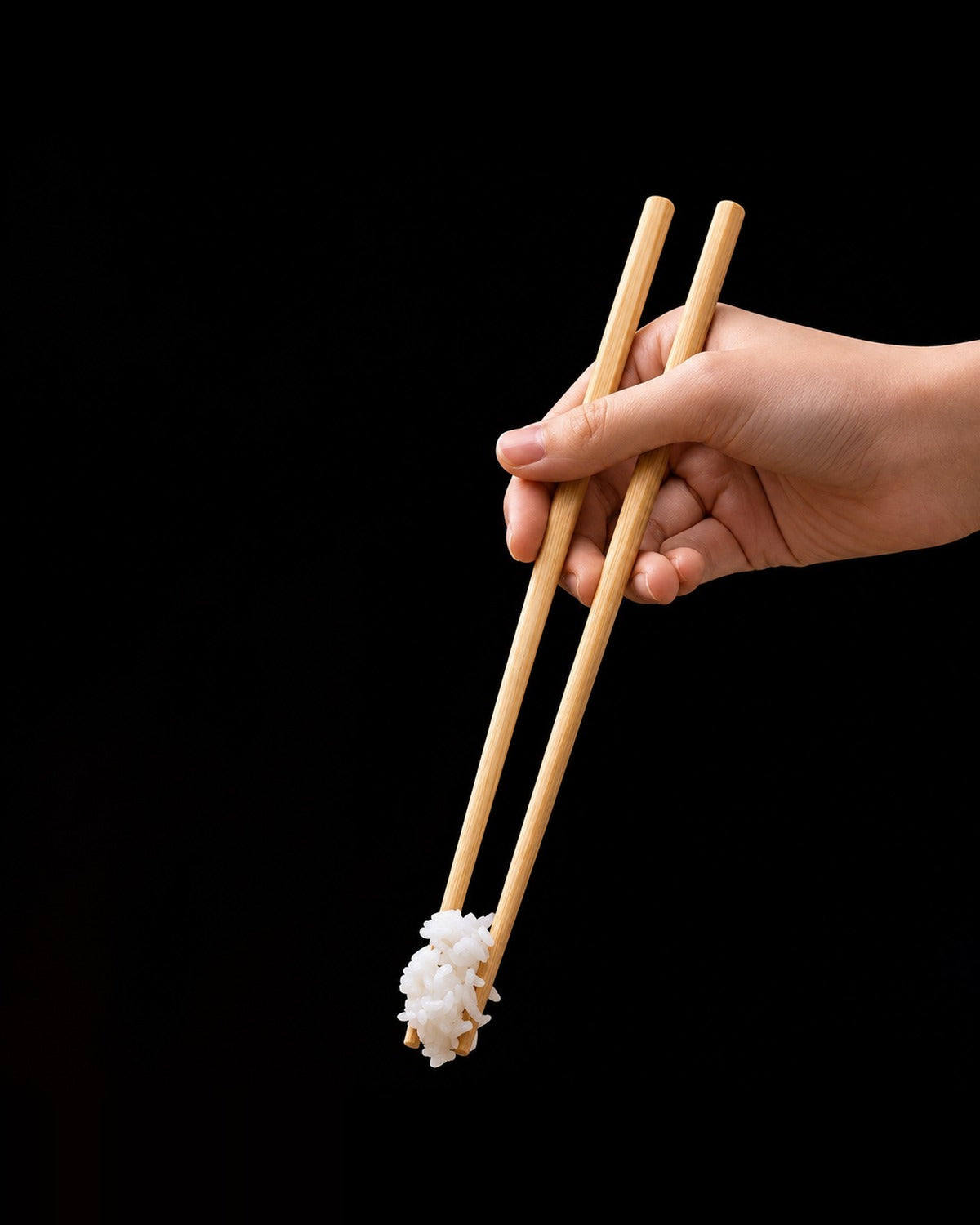
This essay draws on published histories, court and government records, and newspaper and magazine reporting, listed in our notes, rather than on our own reporting in Kolkata. The illustrations were drawn for Passage. The product photograph shows House of Falguni's Bamboo Ritual chopsticks.


