House of Falguni · AhmedabadCraft Resources · Printable

Journaling · Block print · Twenty free sheets

Haath Seहाथ सेJournaling prompts, by hand, for every block print diary

Twenty prompt sheets, one for every block print diary we make. Seven pages for one week, by hand, each drawn from the motifs and craft of one cover.

20 sheets · 140 prompts · free to read here, free to print. By Deesha Goswami. Published 10 October 2026.

A note from the studio

Every diary we make is wrapped in hand block-printed cotton, and every cover is one of a kind: twenty prints, one diary each. We wanted the pages inside to get the same attention as the cloth outside.

Haath se means by hand. Each sheet gives you seven prompts for one week: write, draw, look, make, and on the last day, return to what you made. Every prompt fits one page and takes about ten minutes. The craft notes come from the product page for that cover and from the sources listed below, and where a cover borrows a look, Shibori, Madhubani or Suzani, the sheet says so plainly.

A page written by hand is the one nobody else could have written.

Deesha Goswami, founder, House of Falguni

How it works

  • One page a day
  • By hand, about ten minutes
  • No rubbing out
  • Nobody else has to read it
  1. Pick the sheet for your cover, or any sheet you like. Any notebook works.
  2. Do one prompt a day for seven days, in order. The seventh asks you to look back.
  3. If you make a page you like, share it and tag @houseoffalguni.

Print the sheets

Open the printable sheets

The prompts are free to read below. To print them, leave your email and the PDFs open right here: all twenty in one file, or one sheet at a time.

We will write now and then about new prints. Unsubscribe whenever you like. Privacy policy.

Thank you. Your sheets are open.

Your sheets

All twenty sheets in one file, or print one at a time from the list below.

All twenty sheets (PDF, 20 pages)

The twenty sheets

One for every cover

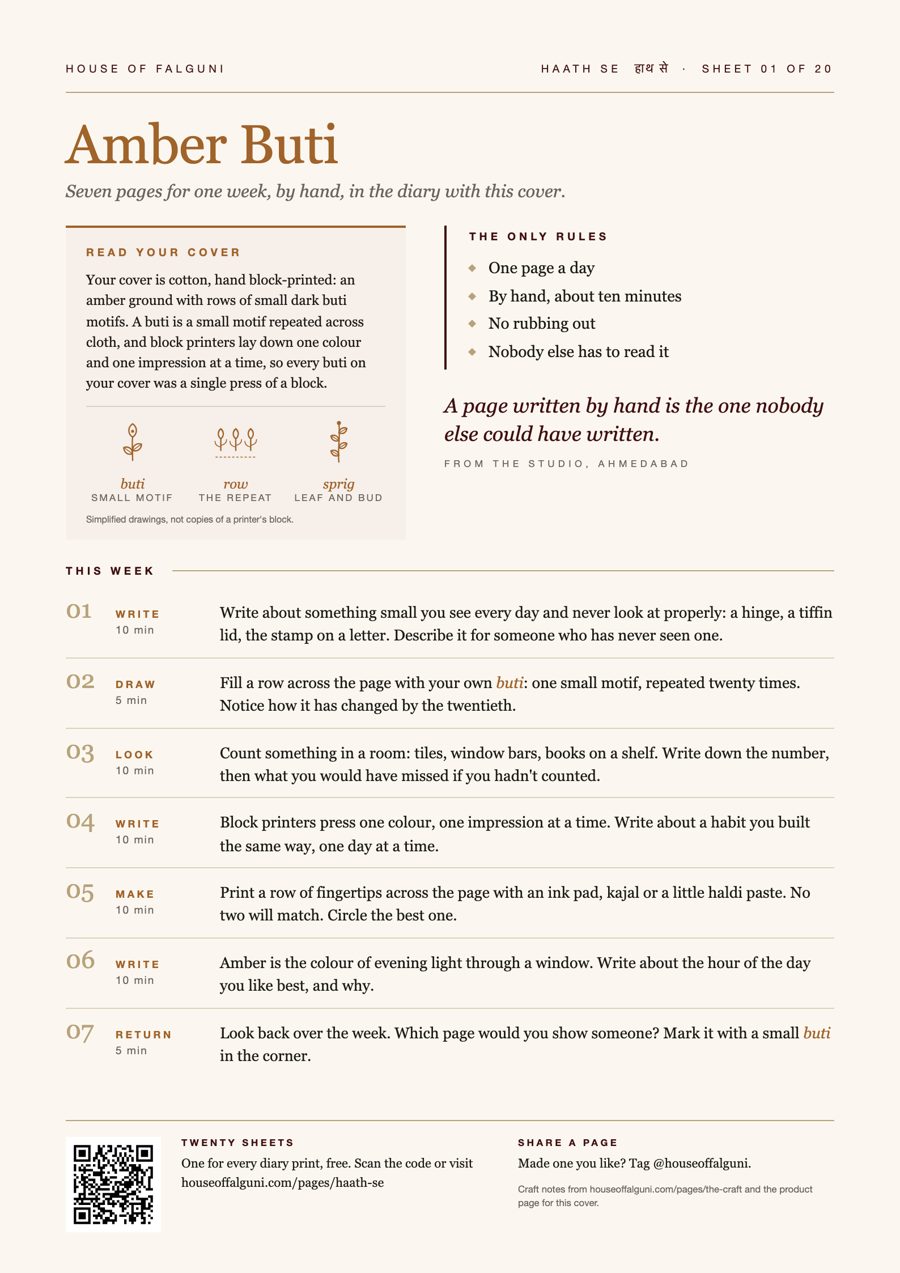
Haath Se prompt sheet 01, Amber Buti: seven journaling prompts for the Amber Buti block print diary

Sheet 01

Amber Buti

Your cover is cotton, hand block-printed: an amber ground with rows of small dark buti motifs. A buti is a small motif repeated across cloth, and block printers lay down one colour and one impression at a time, so every buti on your cover was a single press of a block.

Read the seven prompts
  1. Write10 minWrite about something small you see every day and never look at properly: a hinge, a tiffin lid, the stamp on a letter. Describe it for someone who has never seen one.
  2. Draw5 minFill a row across the page with your own buti: one small motif, repeated twenty times. Notice how it has changed by the twentieth.
  3. Look10 minCount something in a room: tiles, window bars, books on a shelf. Write down the number, then what you would have missed if you hadn't counted.
  4. Write10 minBlock printers press one colour, one impression at a time. Write about a habit you built the same way, one day at a time.
  5. Make10 minPrint a row of fingertips across the page with an ink pad, kajal or a little haldi paste. No two will match. Circle the best one.
  6. Write10 minAmber is the colour of evening light through a window. Write about the hour of the day you like best, and why.
  7. Return5 minLook back over the week. Which page would you show someone? Mark it with a small buti in the corner.
Print this sheet (PDF)Print this sheetSee the Amber Buti diary
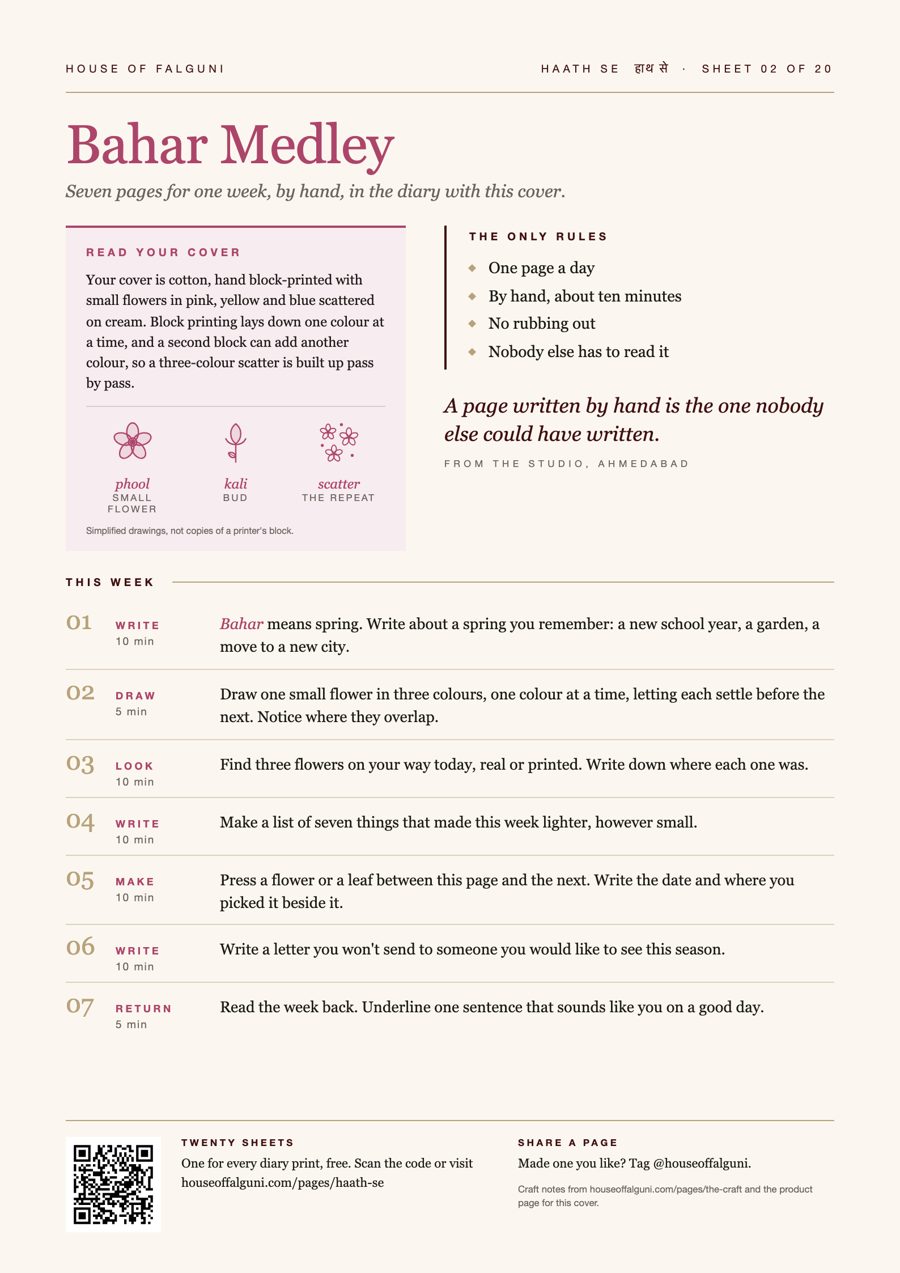
Haath Se prompt sheet 02, Bahar Medley: seven journaling prompts for the Bahar Medley block print diary

Sheet 02

Bahar Medley

Your cover is cotton, hand block-printed with small flowers in pink, yellow and blue scattered on cream. Block printing lays down one colour at a time, and a second block can add another colour, so a three-colour scatter is built up pass by pass.

Read the seven prompts
  1. Write10 minBahar means spring. Write about a spring you remember: a new school year, a garden, a move to a new city.
  2. Draw5 minDraw one small flower in three colours, one colour at a time, letting each settle before the next. Notice where they overlap.
  3. Look10 minFind three flowers on your way today, real or printed. Write down where each one was.
  4. Write10 minMake a list of seven things that made this week lighter, however small.
  5. Make10 minPress a flower or a leaf between this page and the next. Write the date and where you picked it beside it.
  6. Write10 minWrite a letter you won't send to someone you would like to see this season.
  7. Return5 minRead the week back. Underline one sentence that sounds like you on a good day.
Print this sheet (PDF)Print this sheetSee the Bahar Medley diary
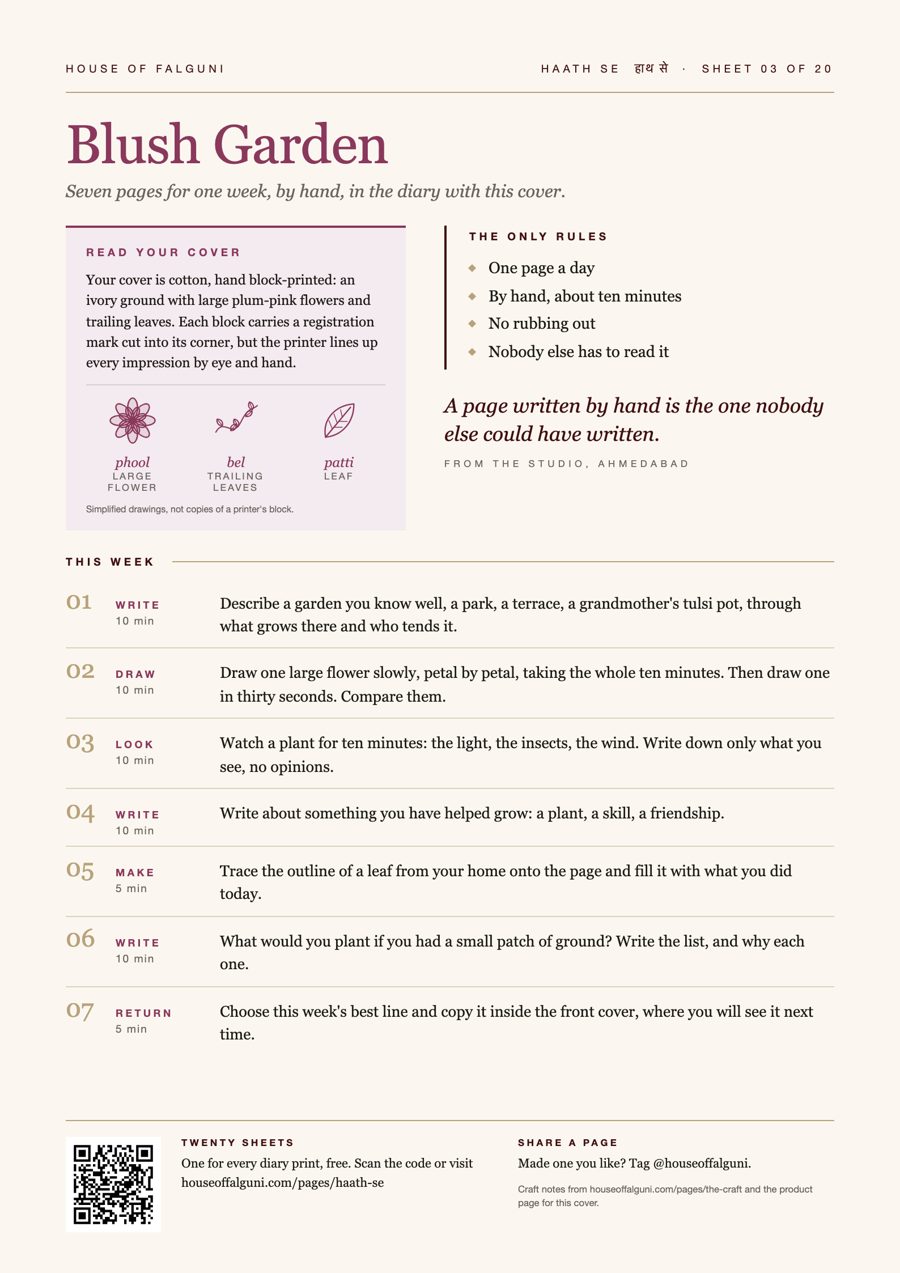
Haath Se prompt sheet 03, Blush Garden: seven journaling prompts for the Blush Garden block print diary

Sheet 03

Blush Garden

Your cover is cotton, hand block-printed: an ivory ground with large plum-pink flowers and trailing leaves. Each block carries a registration mark cut into its corner, but the printer lines up every impression by eye and hand.

Read the seven prompts
  1. Write10 minDescribe a garden you know well, a park, a terrace, a grandmother's tulsi pot, through what grows there and who tends it.
  2. Draw10 minDraw one large flower slowly, petal by petal, taking the whole ten minutes. Then draw one in thirty seconds. Compare them.
  3. Look10 minWatch a plant for ten minutes: the light, the insects, the wind. Write down only what you see, no opinions.
  4. Write10 minWrite about something you have helped grow: a plant, a skill, a friendship.
  5. Make5 minTrace the outline of a leaf from your home onto the page and fill it with what you did today.
  6. Write10 minWhat would you plant if you had a small patch of ground? Write the list, and why each one.
  7. Return5 minChoose this week's best line and copy it inside the front cover, where you will see it next time.
Print this sheet (PDF)Print this sheetSee the Blush Garden diary
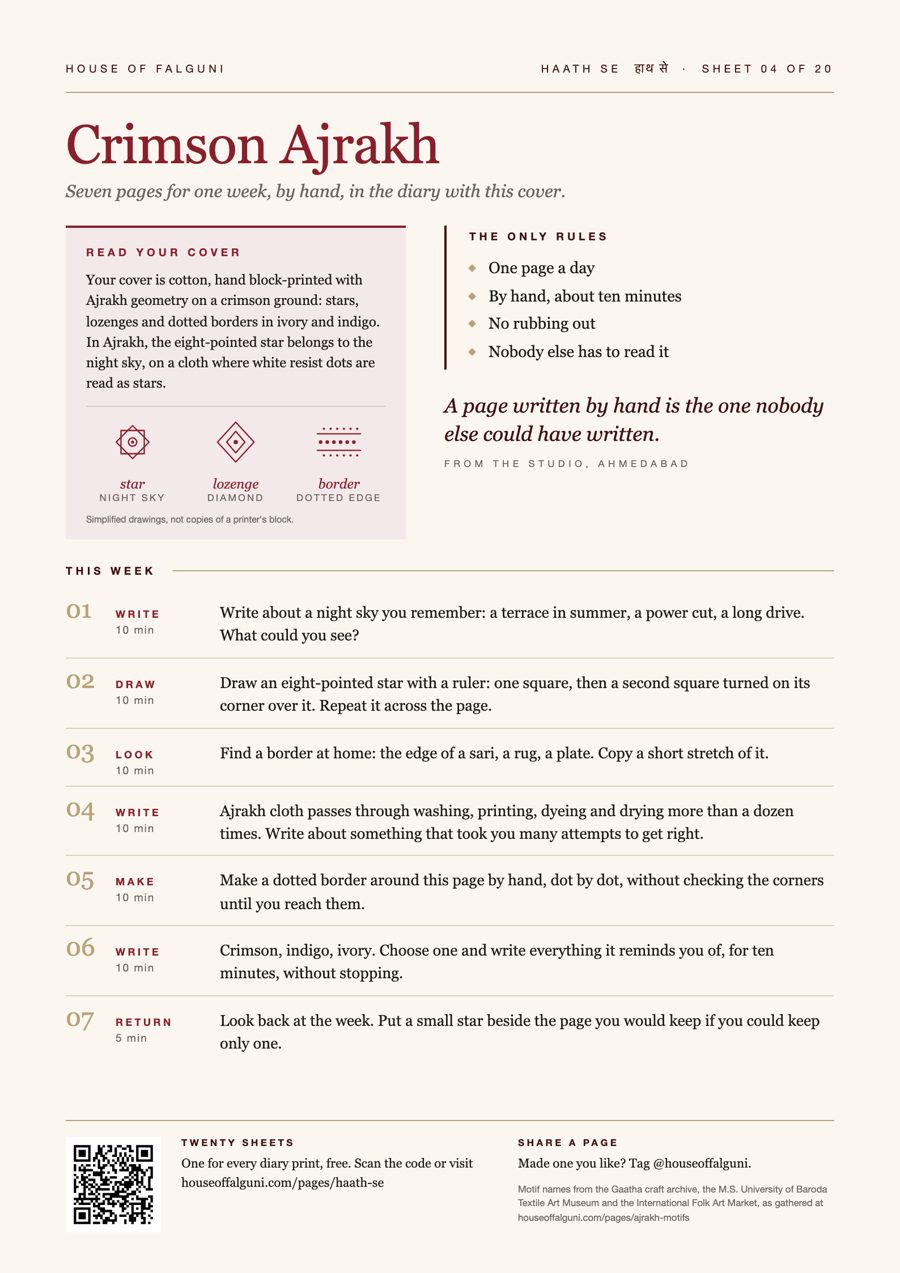
Haath Se prompt sheet 04, Crimson Ajrakh: seven journaling prompts for the Crimson Ajrakh block print diary

Sheet 04

Crimson Ajrakh

Your cover is cotton, hand block-printed with Ajrakh geometry on a crimson ground: stars, lozenges and dotted borders in ivory and indigo. In Ajrakh, the eight-pointed star belongs to the night sky, on a cloth where white resist dots are read as stars.

Read the seven prompts
  1. Write10 minWrite about a night sky you remember: a terrace in summer, a power cut, a long drive. What could you see?
  2. Draw10 minDraw an eight-pointed star with a ruler: one square, then a second square turned on its corner over it. Repeat it across the page.
  3. Look10 minFind a border at home: the edge of a sari, a rug, a plate. Copy a short stretch of it.
  4. Write10 minAjrakh cloth passes through washing, printing, dyeing and drying more than a dozen times. Write about something that took you many attempts to get right.
  5. Make10 minMake a dotted border around this page by hand, dot by dot, without checking the corners until you reach them.
  6. Write10 minCrimson, indigo, ivory. Choose one and write everything it reminds you of, for ten minutes, without stopping.
  7. Return5 minLook back at the week. Put a small star beside the page you would keep if you could keep only one.
Print this sheet (PDF)Print this sheetSee the Crimson Ajrakh diary
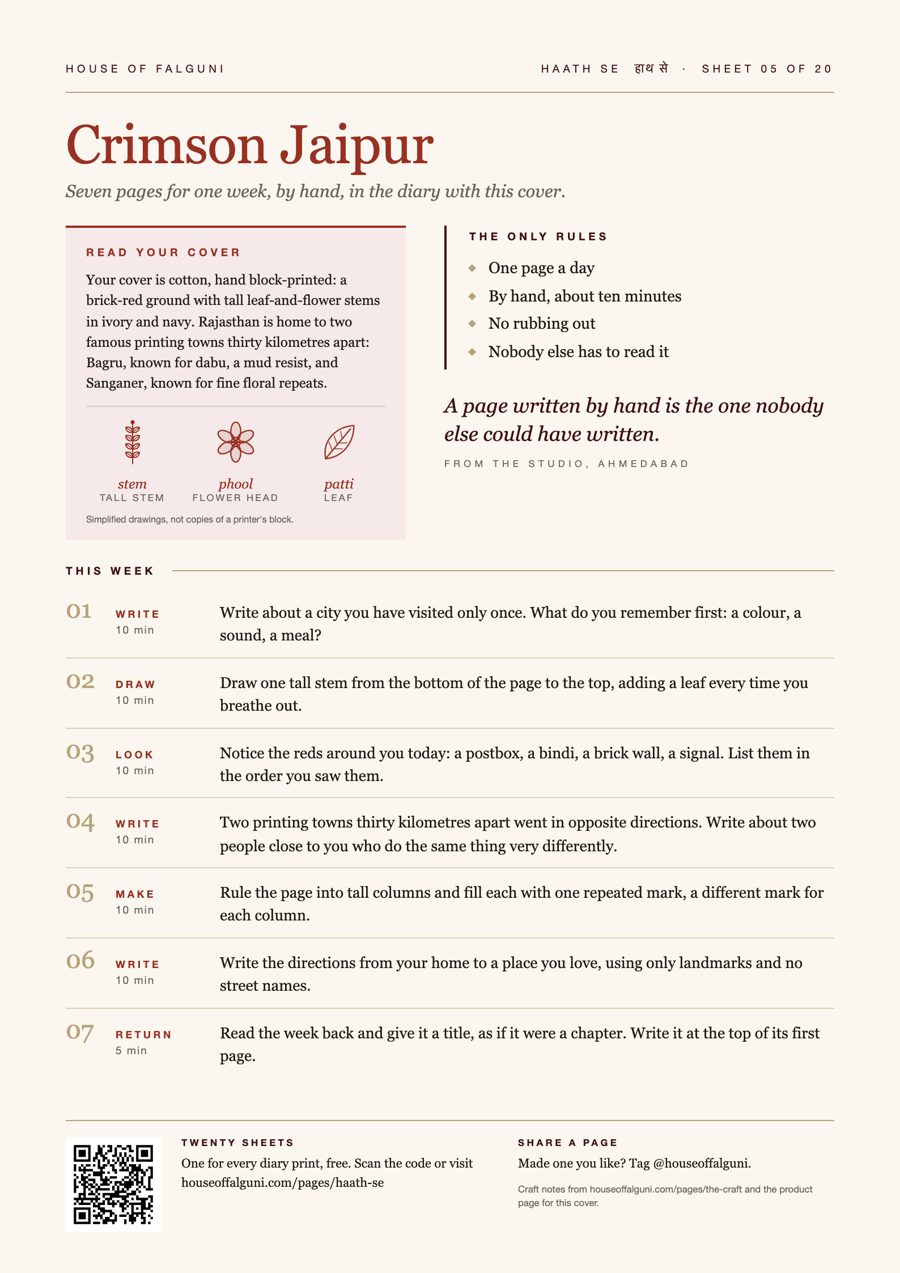
Haath Se prompt sheet 05, Crimson Jaipur: seven journaling prompts for the Crimson Jaipur block print diary

Sheet 05

Crimson Jaipur

Your cover is cotton, hand block-printed: a brick-red ground with tall leaf-and-flower stems in ivory and navy. Rajasthan is home to two famous printing towns thirty kilometres apart: Bagru, known for dabu, a mud resist, and Sanganer, known for fine floral repeats.

Read the seven prompts
  1. Write10 minWrite about a city you have visited only once. What do you remember first: a colour, a sound, a meal?
  2. Draw10 minDraw one tall stem from the bottom of the page to the top, adding a leaf every time you breathe out.
  3. Look10 minNotice the reds around you today: a postbox, a bindi, a brick wall, a signal. List them in the order you saw them.
  4. Write10 minTwo printing towns thirty kilometres apart went in opposite directions. Write about two people close to you who do the same thing very differently.
  5. Make10 minRule the page into tall columns and fill each with one repeated mark, a different mark for each column.
  6. Write10 minWrite the directions from your home to a place you love, using only landmarks and no street names.
  7. Return5 minRead the week back and give it a title, as if it were a chapter. Write it at the top of its first page.
Print this sheet (PDF)Print this sheetSee the Crimson Jaipur diary
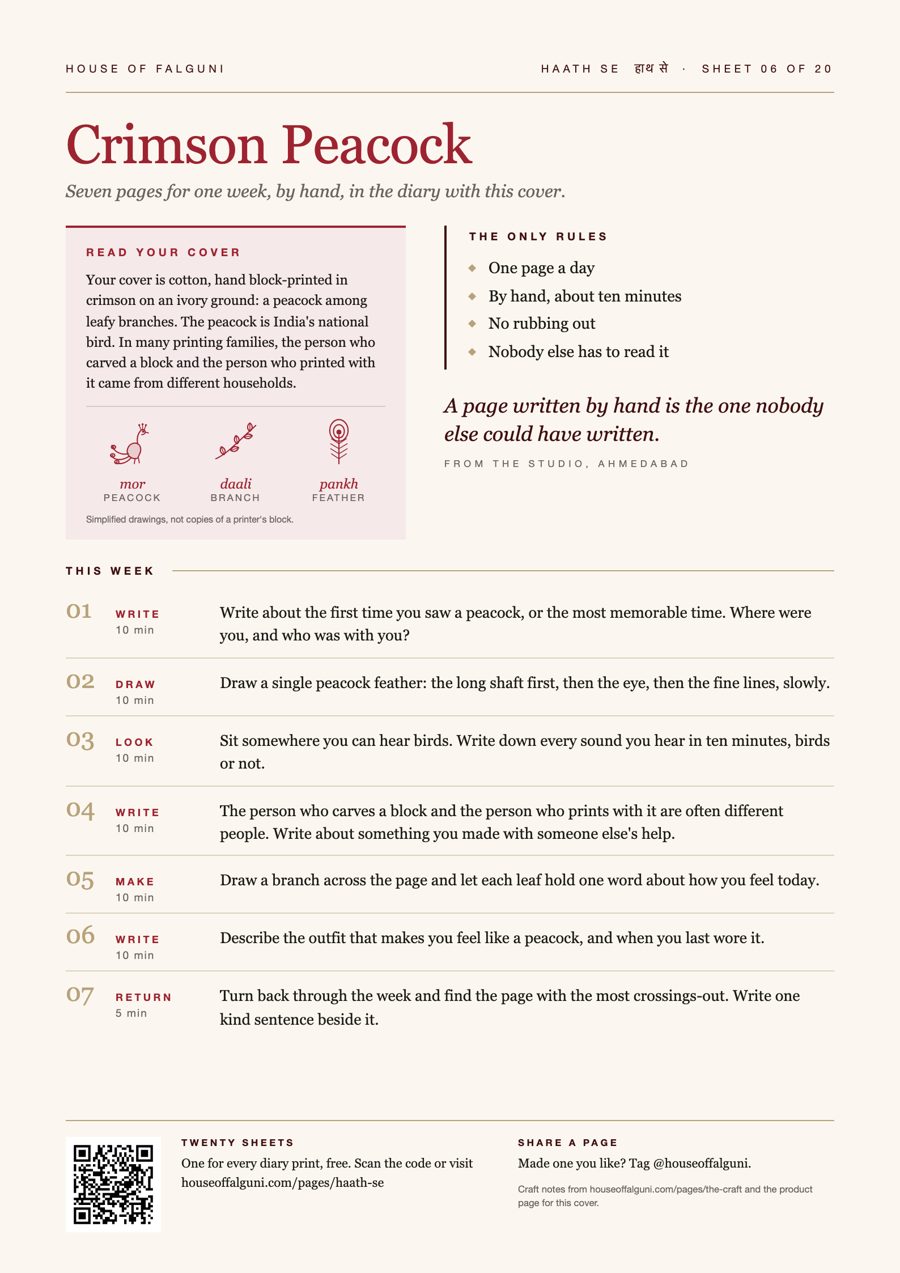
Haath Se prompt sheet 06, Crimson Peacock: seven journaling prompts for the Crimson Peacock block print diary

Sheet 06

Crimson Peacock

Your cover is cotton, hand block-printed in crimson on an ivory ground: a peacock among leafy branches. The peacock is India's national bird. In many printing families, the person who carved a block and the person who printed with it came from different households.

Read the seven prompts
  1. Write10 minWrite about the first time you saw a peacock, or the most memorable time. Where were you, and who was with you?
  2. Draw10 minDraw a single peacock feather: the long shaft first, then the eye, then the fine lines, slowly.
  3. Look10 minSit somewhere you can hear birds. Write down every sound you hear in ten minutes, birds or not.
  4. Write10 minThe person who carves a block and the person who prints with it are often different people. Write about something you made with someone else's help.
  5. Make10 minDraw a branch across the page and let each leaf hold one word about how you feel today.
  6. Write10 minDescribe the outfit that makes you feel like a peacock, and when you last wore it.
  7. Return5 minTurn back through the week and find the page with the most crossings-out. Write one kind sentence beside it.
Print this sheet (PDF)Print this sheetSee the Crimson Peacock diary
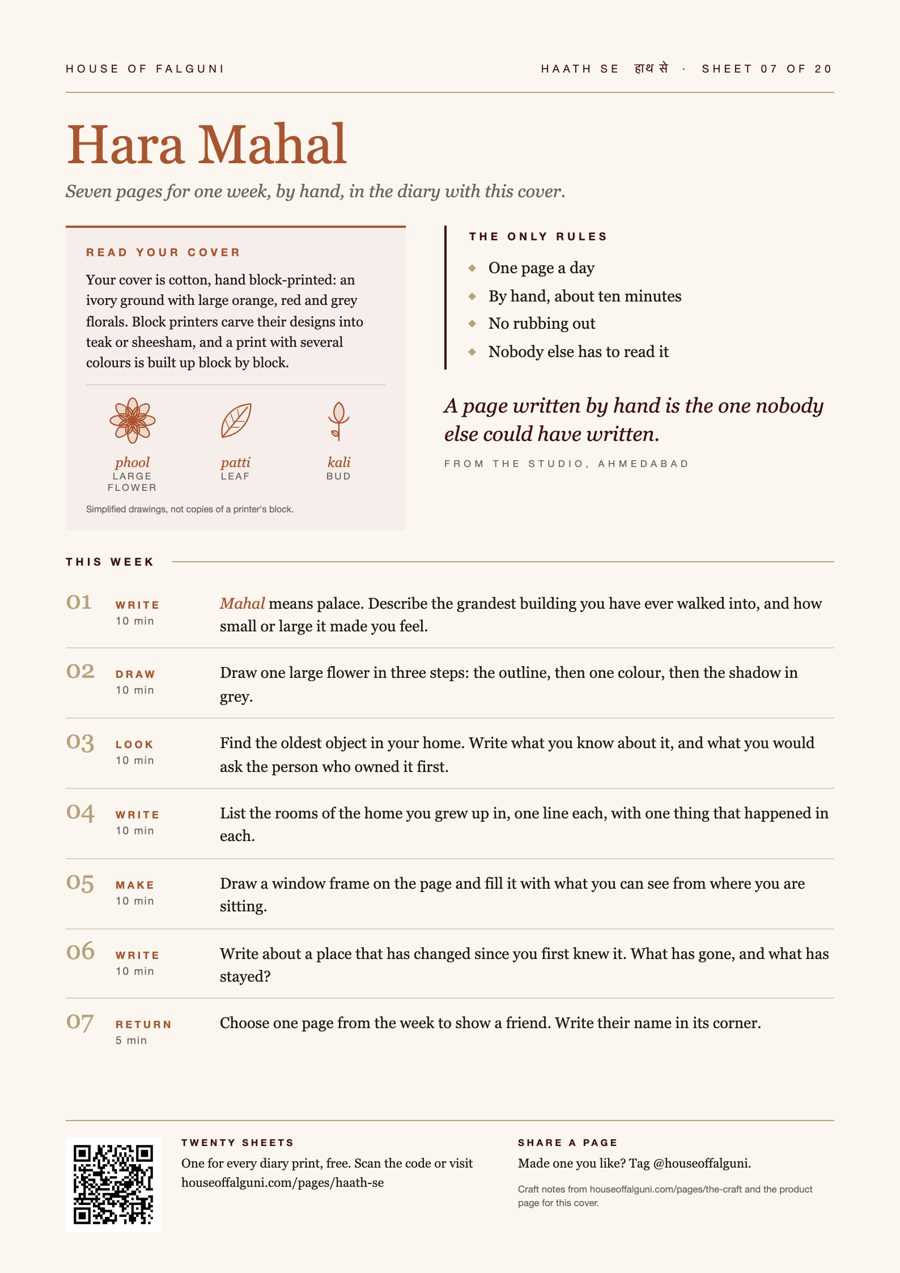
Haath Se prompt sheet 07, Hara Mahal: seven journaling prompts for the Hara Mahal block print diary

Sheet 07

Hara Mahal

Your cover is cotton, hand block-printed: an ivory ground with large orange, red and grey florals. Block printers carve their designs into teak or sheesham, and a print with several colours is built up block by block.

Read the seven prompts
  1. Write10 minMahal means palace. Describe the grandest building you have ever walked into, and how small or large it made you feel.
  2. Draw10 minDraw one large flower in three steps: the outline, then one colour, then the shadow in grey.
  3. Look10 minFind the oldest object in your home. Write what you know about it, and what you would ask the person who owned it first.
  4. Write10 minList the rooms of the home you grew up in, one line each, with one thing that happened in each.
  5. Make10 minDraw a window frame on the page and fill it with what you can see from where you are sitting.
  6. Write10 minWrite about a place that has changed since you first knew it. What has gone, and what has stayed?
  7. Return5 minChoose one page from the week to show a friend. Write their name in its corner.
Print this sheet (PDF)Print this sheetSee the Hara Mahal diary
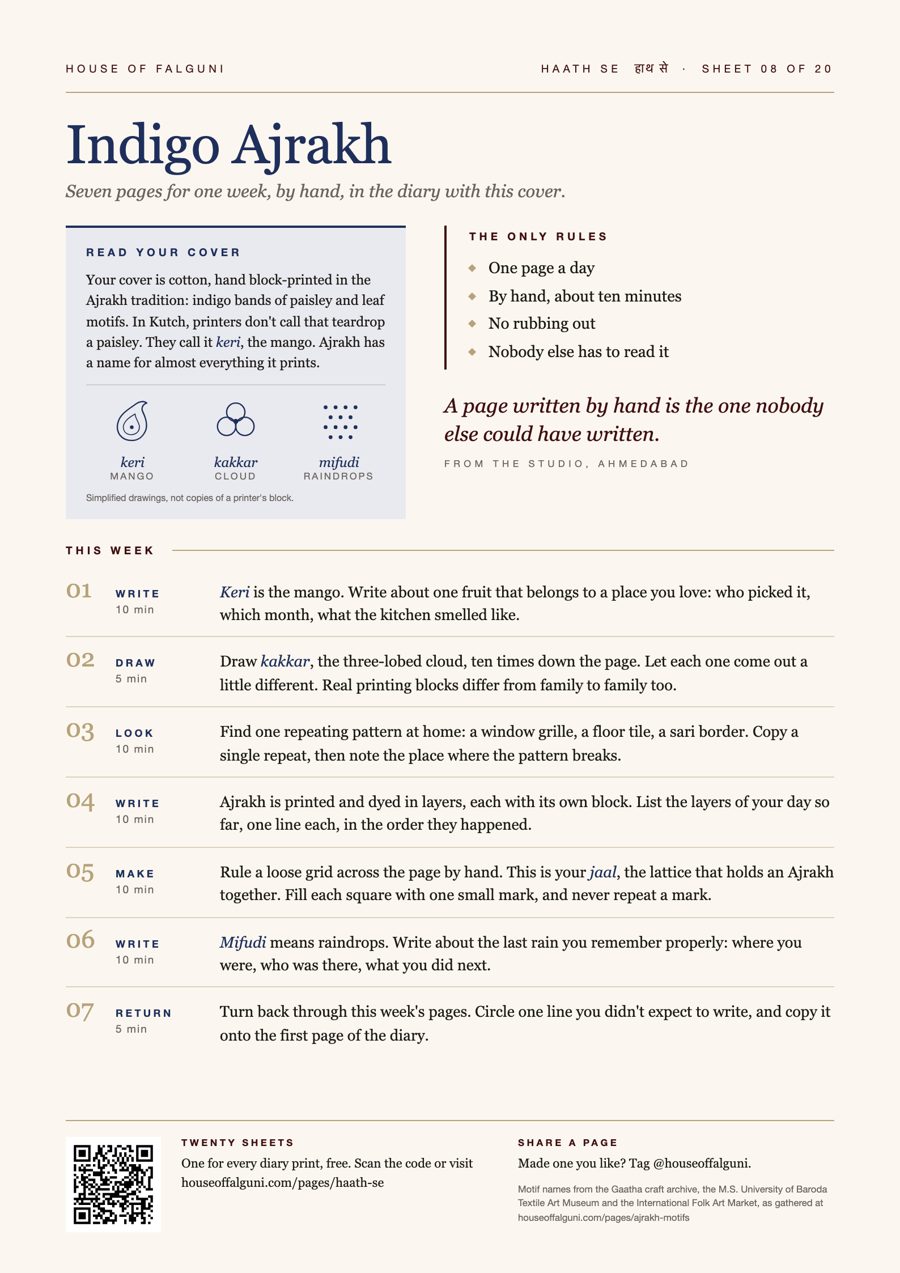
Haath Se prompt sheet 08, Indigo Ajrakh: seven journaling prompts for the Indigo Ajrakh block print diary

Sheet 08

Indigo Ajrakh

Your cover is cotton, hand block-printed in the Ajrakh tradition: indigo bands of paisley and leaf motifs. In Kutch, printers don't call that teardrop a paisley. They call it keri, the mango. Ajrakh has a name for almost everything it prints.

Read the seven prompts
  1. Write10 minKeri is the mango. Write about one fruit that belongs to a place you love: who picked it, which month, what the kitchen smelled like.
  2. Draw5 minDraw kakkar, the three-lobed cloud, ten times down the page. Let each one come out a little different. Real printing blocks differ from family to family too.
  3. Look10 minFind one repeating pattern at home: a window grille, a floor tile, a sari border. Copy a single repeat, then note the place where the pattern breaks.
  4. Write10 minAjrakh is printed and dyed in layers, each with its own block. List the layers of your day so far, one line each, in the order they happened.
  5. Make10 minRule a loose grid across the page by hand. This is your jaal, the lattice that holds an Ajrakh together. Fill each square with one small mark, and never repeat a mark.
  6. Write10 minMifudi means raindrops. Write about the last rain you remember properly: where you were, who was there, what you did next.
  7. Return5 minTurn back through this week's pages. Circle one line you didn't expect to write, and copy it onto the first page of the diary.
Print this sheet (PDF)Print this sheetSee the Indigo Ajrakh diary
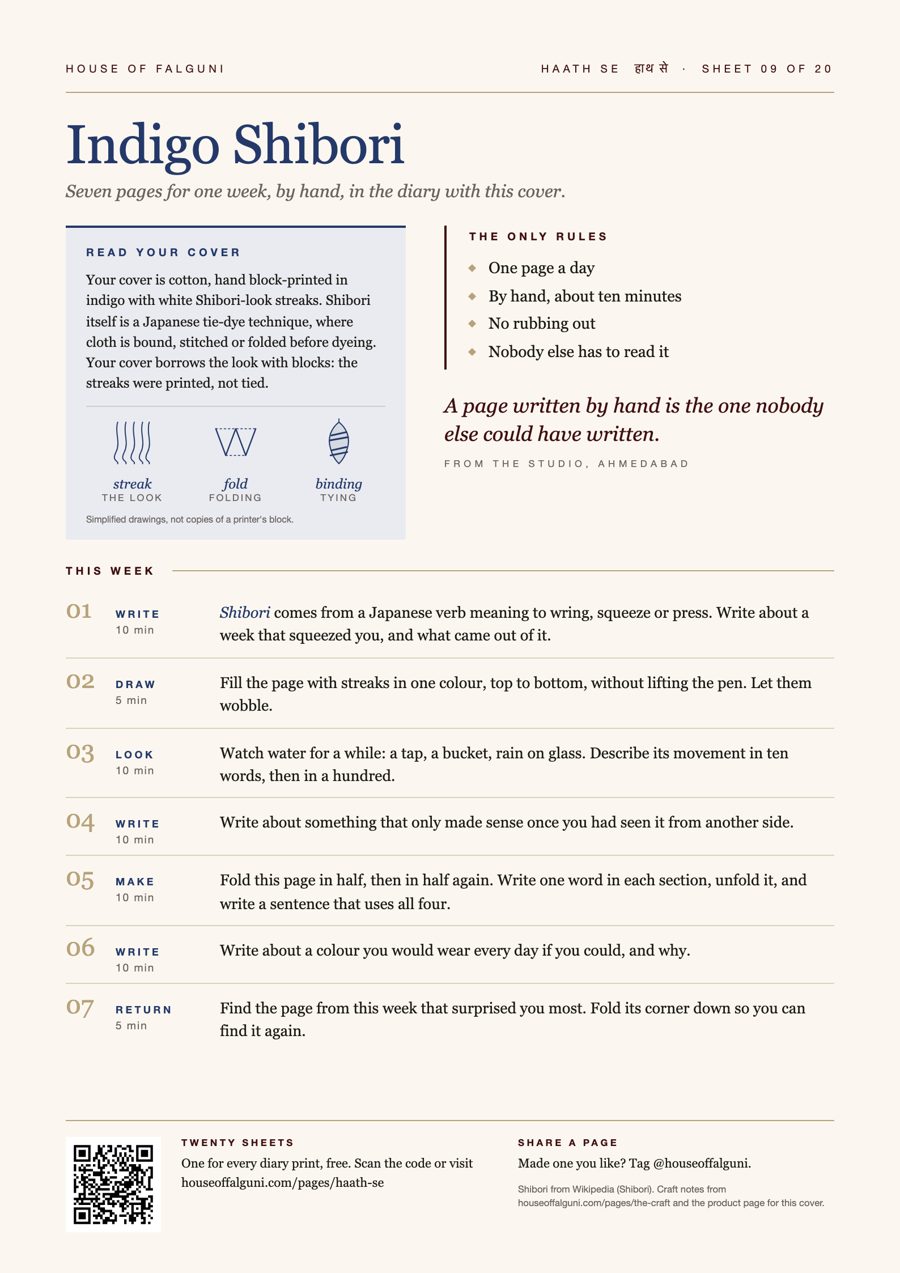
Haath Se prompt sheet 09, Indigo Shibori: seven journaling prompts for the Indigo Shibori block print diary

Sheet 09

Indigo Shibori

Your cover is cotton, hand block-printed in indigo with white Shibori-look streaks. Shibori itself is a Japanese tie-dye technique, where cloth is bound, stitched or folded before dyeing. Your cover borrows the look with blocks: the streaks were printed, not tied.

Read the seven prompts
  1. Write10 minShibori comes from a Japanese verb meaning to wring, squeeze or press. Write about a week that squeezed you, and what came out of it.
  2. Draw5 minFill the page with streaks in one colour, top to bottom, without lifting the pen. Let them wobble.
  3. Look10 minWatch water for a while: a tap, a bucket, rain on glass. Describe its movement in ten words, then in a hundred.
  4. Write10 minWrite about something that only made sense once you had seen it from another side.
  5. Make10 minFold this page in half, then in half again. Write one word in each section, unfold it, and write a sentence that uses all four.
  6. Write10 minWrite about a colour you would wear every day if you could, and why.
  7. Return5 minFind the page from this week that surprised you most. Fold its corner down so you can find it again.
Print this sheet (PDF)Print this sheetSee the Indigo Shibori diary
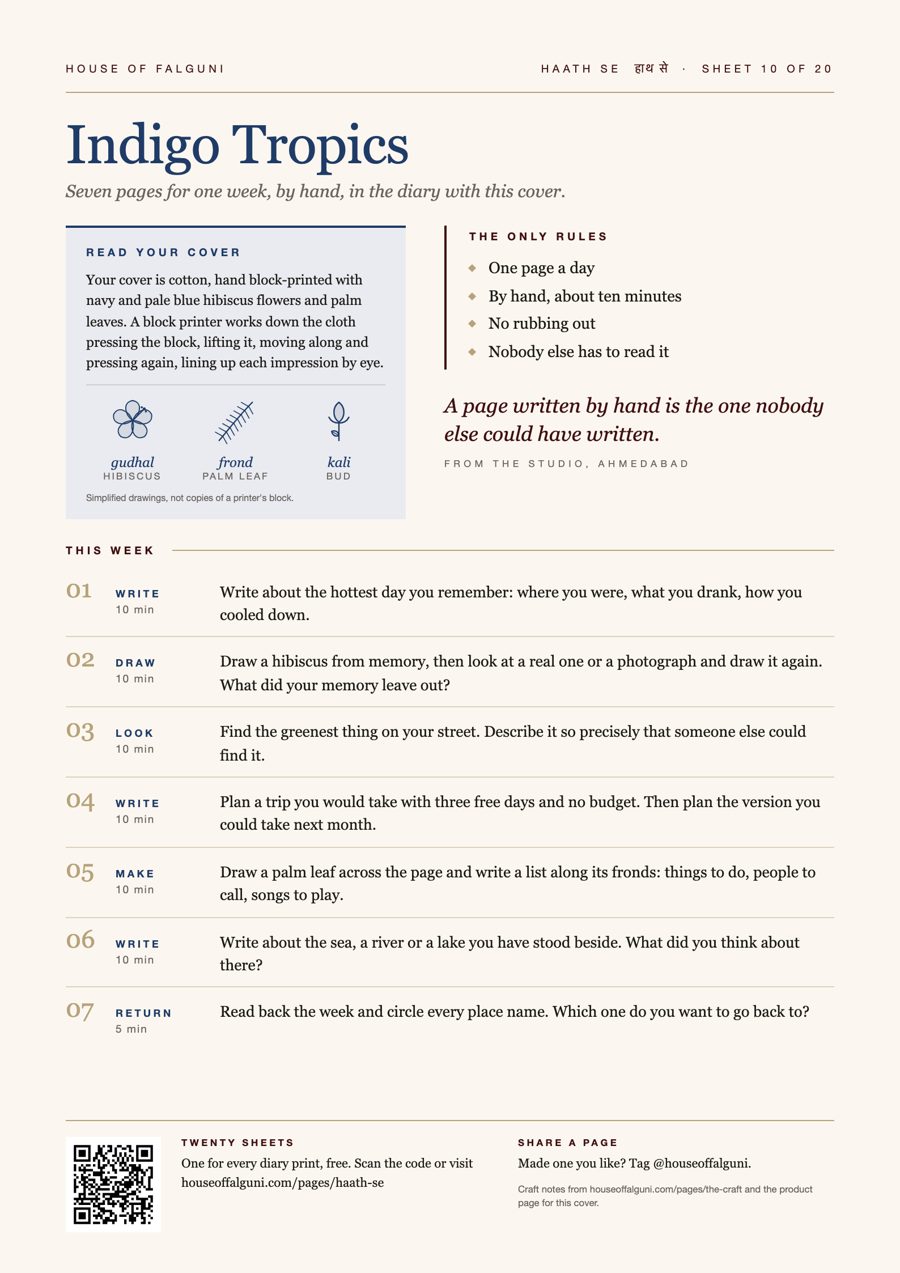
Haath Se prompt sheet 10, Indigo Tropics: seven journaling prompts for the Indigo Tropics block print diary

Sheet 10

Indigo Tropics

Your cover is cotton, hand block-printed with navy and pale blue hibiscus flowers and palm leaves. A block printer works down the cloth pressing the block, lifting it, moving along and pressing again, lining up each impression by eye.

Read the seven prompts
  1. Write10 minWrite about the hottest day you remember: where you were, what you drank, how you cooled down.
  2. Draw10 minDraw a hibiscus from memory, then look at a real one or a photograph and draw it again. What did your memory leave out?
  3. Look10 minFind the greenest thing on your street. Describe it so precisely that someone else could find it.
  4. Write10 minPlan a trip you would take with three free days and no budget. Then plan the version you could take next month.
  5. Make10 minDraw a palm leaf across the page and write a list along its fronds: things to do, people to call, songs to play.
  6. Write10 minWrite about the sea, a river or a lake you have stood beside. What did you think about there?
  7. Return5 minRead back the week and circle every place name. Which one do you want to go back to?
Print this sheet (PDF)Print this sheetSee the Indigo Tropics diary
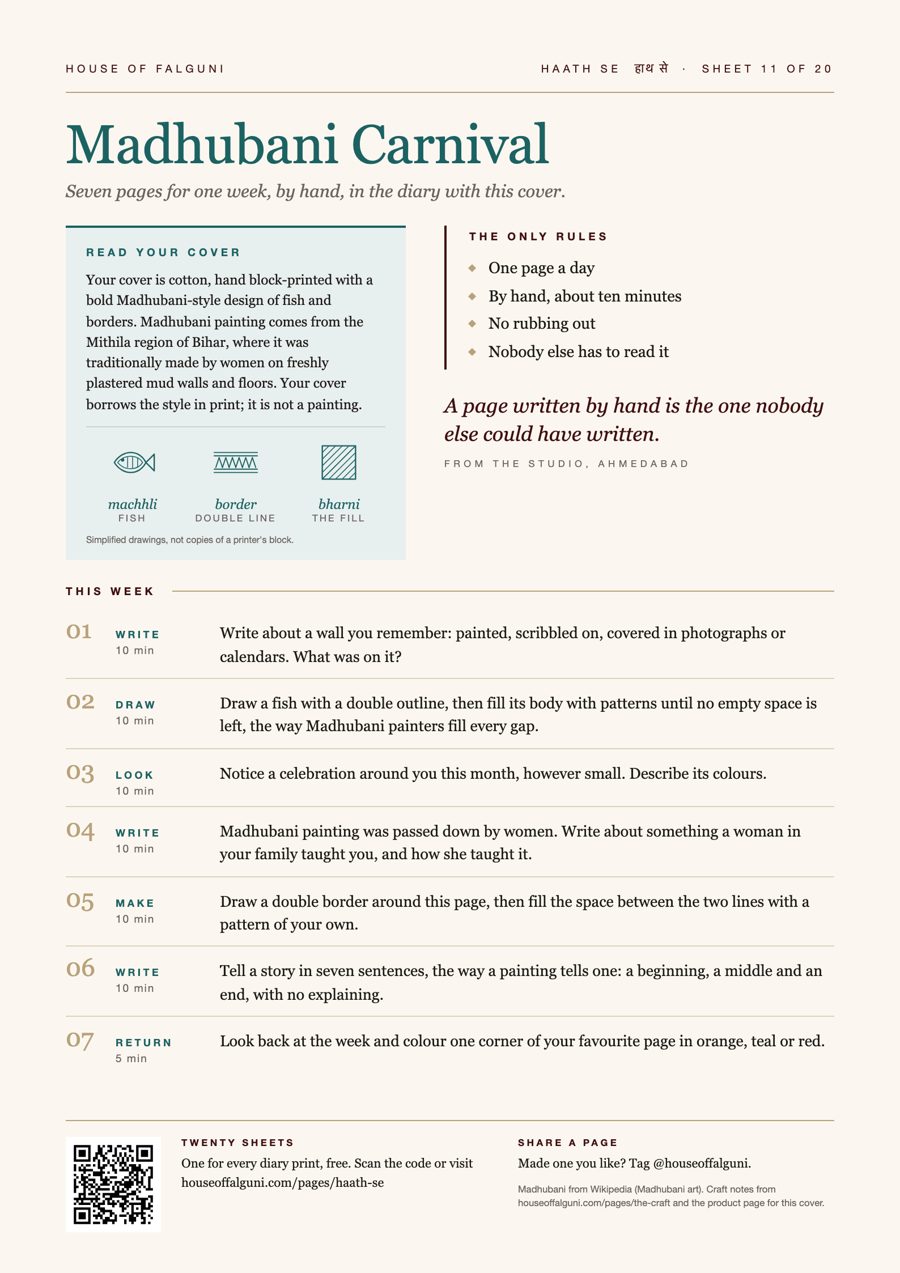
Haath Se prompt sheet 11, Madhubani Carnival: seven journaling prompts for the Madhubani Carnival block print diary

Sheet 11

Madhubani Carnival

Your cover is cotton, hand block-printed with a bold Madhubani-style design of fish and borders. Madhubani painting comes from the Mithila region of Bihar, where it was traditionally made by women on freshly plastered mud walls and floors. Your cover borrows the style in print; it is not a painting.

Read the seven prompts
  1. Write10 minWrite about a wall you remember: painted, scribbled on, covered in photographs or calendars. What was on it?
  2. Draw10 minDraw a fish with a double outline, then fill its body with patterns until no empty space is left, the way Madhubani painters fill every gap.
  3. Look10 minNotice a celebration around you this month, however small. Describe its colours.
  4. Write10 minMadhubani painting was passed down by women. Write about something a woman in your family taught you, and how she taught it.
  5. Make10 minDraw a double border around this page, then fill the space between the two lines with a pattern of your own.
  6. Write10 minTell a story in seven sentences, the way a painting tells one: a beginning, a middle and an end, with no explaining.
  7. Return5 minLook back at the week and colour one corner of your favourite page in orange, teal or red.
Print this sheet (PDF)Print this sheetSee the Madhubani Carnival diary
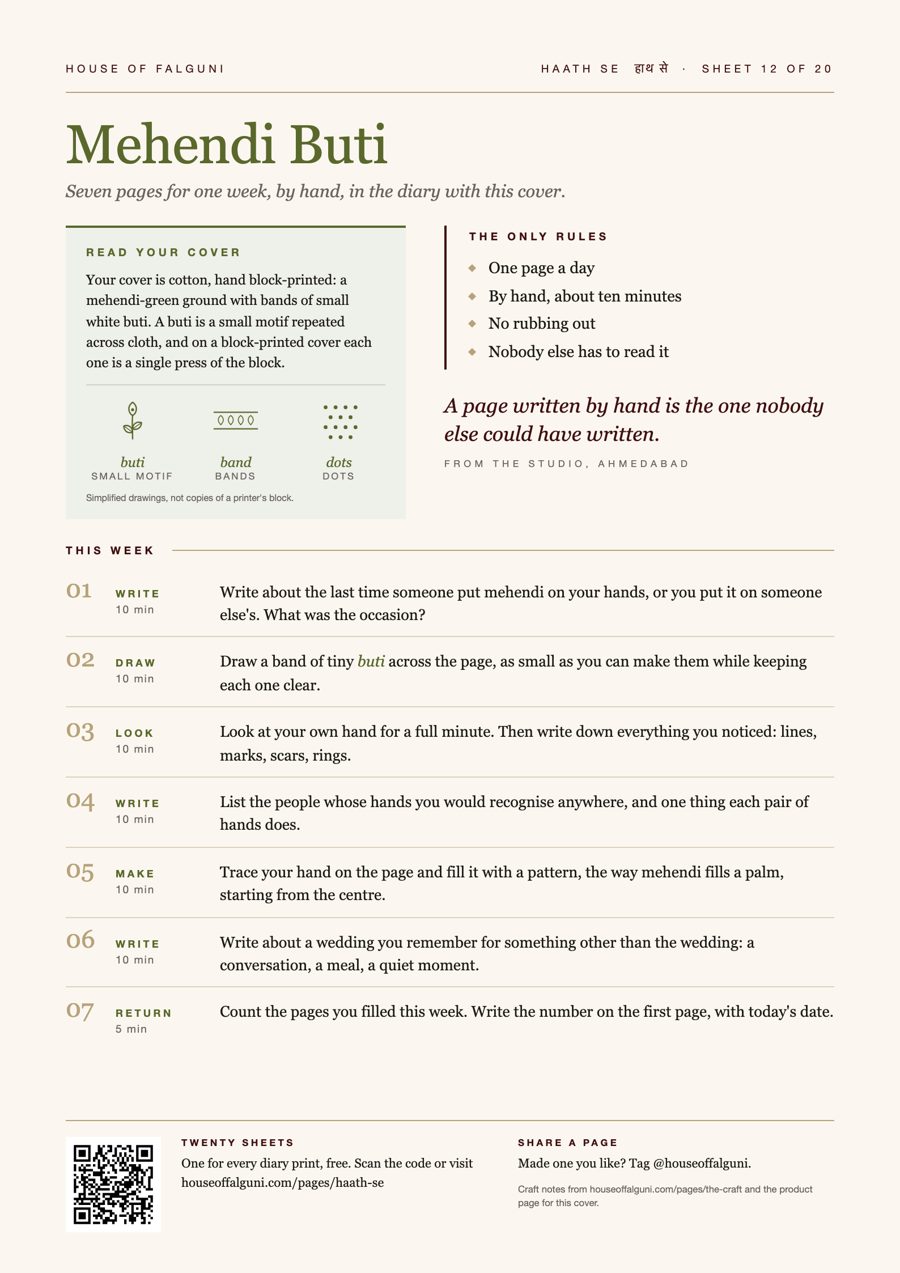
Haath Se prompt sheet 12, Mehendi Buti: seven journaling prompts for the Mehendi Buti block print diary

Sheet 12

Mehendi Buti

Your cover is cotton, hand block-printed: a mehendi-green ground with bands of small white buti. A buti is a small motif repeated across cloth, and on a block-printed cover each one is a single press of the block.

Read the seven prompts
  1. Write10 minWrite about the last time someone put mehendi on your hands, or you put it on someone else's. What was the occasion?
  2. Draw10 minDraw a band of tiny buti across the page, as small as you can make them while keeping each one clear.
  3. Look10 minLook at your own hand for a full minute. Then write down everything you noticed: lines, marks, scars, rings.
  4. Write10 minList the people whose hands you would recognise anywhere, and one thing each pair of hands does.
  5. Make10 minTrace your hand on the page and fill it with a pattern, the way mehendi fills a palm, starting from the centre.
  6. Write10 minWrite about a wedding you remember for something other than the wedding: a conversation, a meal, a quiet moment.
  7. Return5 minCount the pages you filled this week. Write the number on the first page, with today's date.
Print this sheet (PDF)Print this sheetSee the Mehendi Buti diary
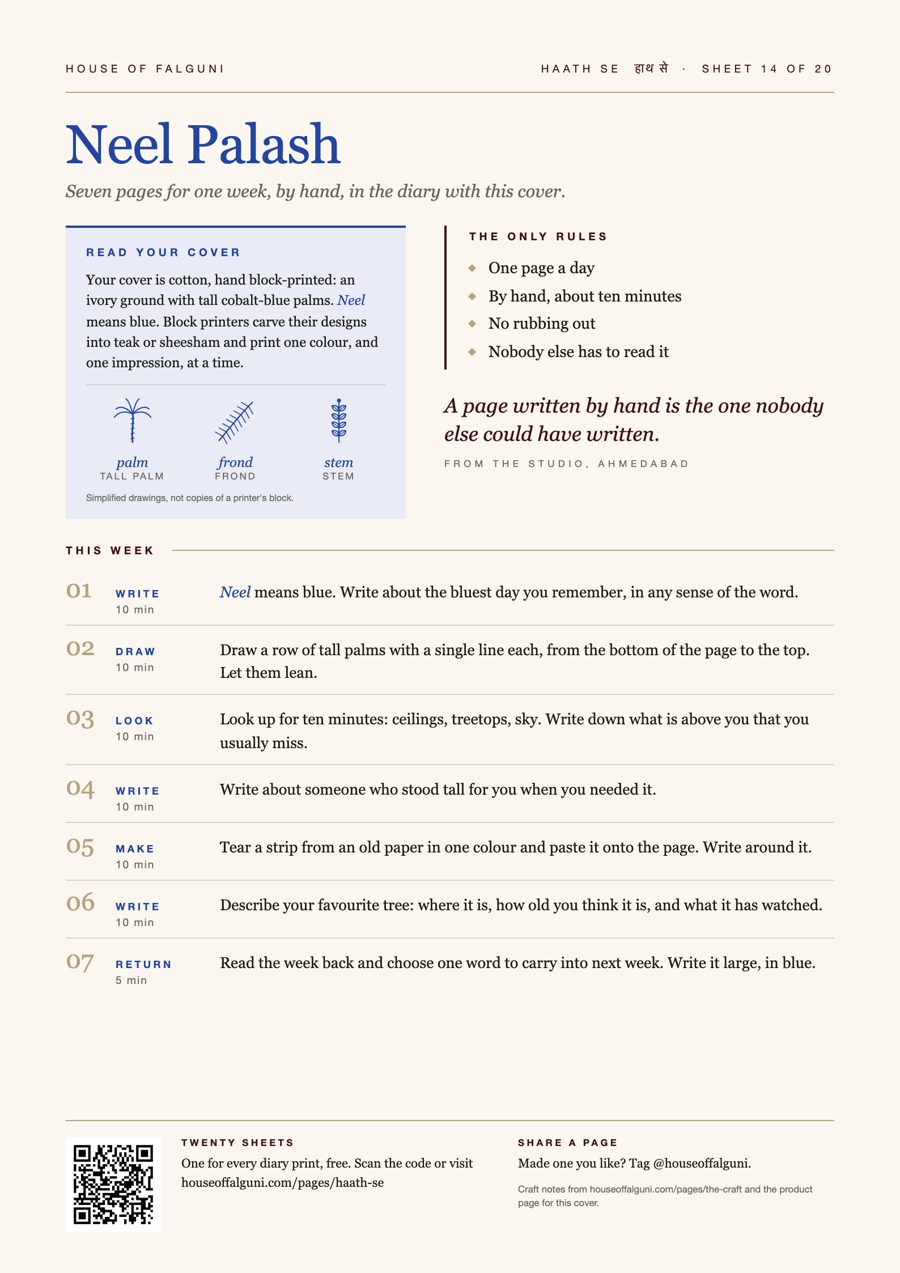
Haath Se prompt sheet 14, Neel Palash: seven journaling prompts for the Neel Palash block print diary

Sheet 14

Neel Palash

Your cover is cotton, hand block-printed: an ivory ground with tall cobalt-blue palms. Neel means blue. Block printers carve their designs into teak or sheesham and print one colour, and one impression, at a time.

Read the seven prompts
  1. Write10 minNeel means blue. Write about the bluest day you remember, in any sense of the word.
  2. Draw10 minDraw a row of tall palms with a single line each, from the bottom of the page to the top. Let them lean.
  3. Look10 minLook up for ten minutes: ceilings, treetops, sky. Write down what is above you that you usually miss.
  4. Write10 minWrite about someone who stood tall for you when you needed it.
  5. Make10 minTear a strip from an old paper in one colour and paste it onto the page. Write around it.
  6. Write10 minDescribe your favourite tree: where it is, how old you think it is, and what it has watched.
  7. Return5 minRead the week back and choose one word to carry into next week. Write it large, in blue.
Print this sheet (PDF)Print this sheetSee the Neel Palash diary
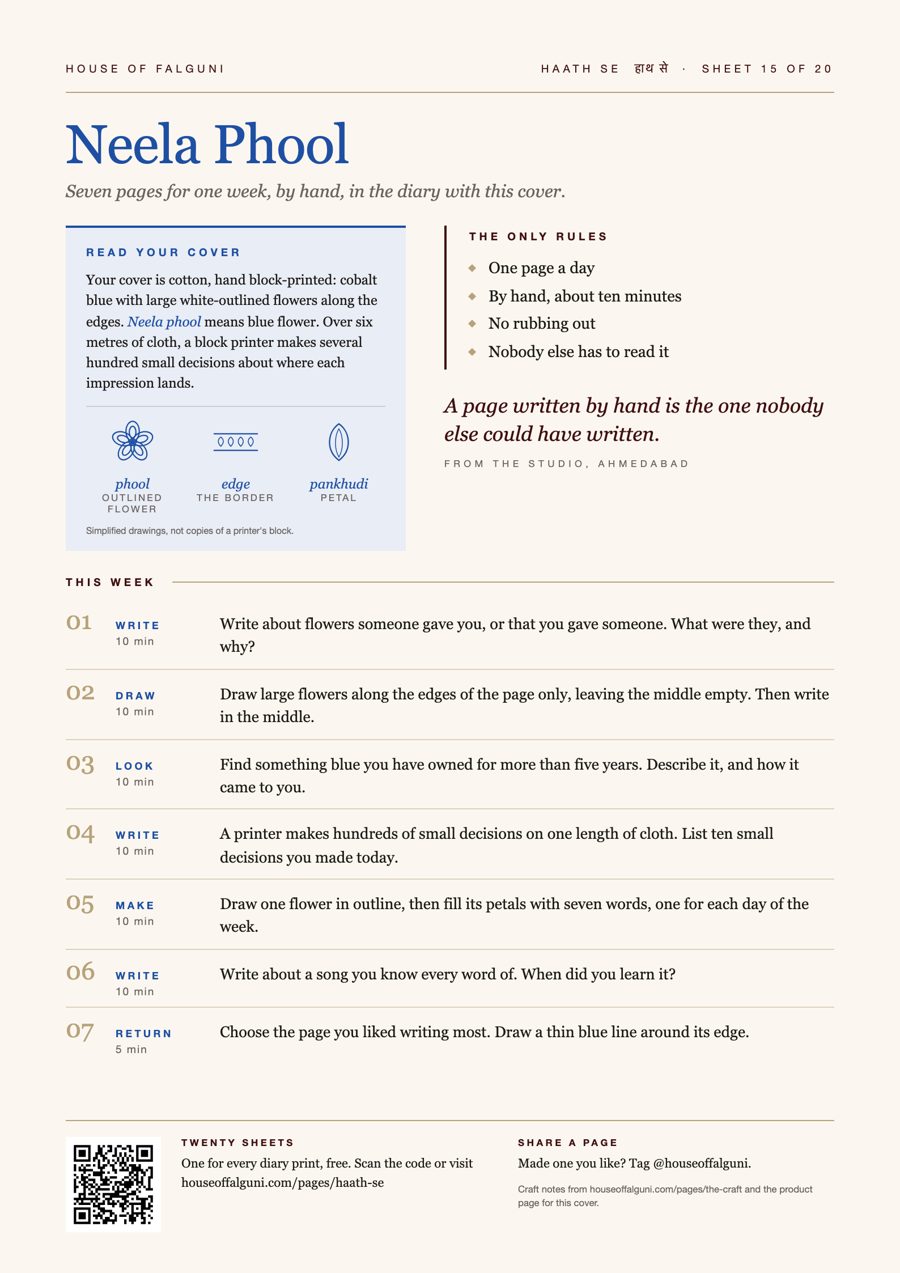
Haath Se prompt sheet 15, Neela Phool: seven journaling prompts for the Neela Phool block print diary

Sheet 15

Neela Phool

Your cover is cotton, hand block-printed: cobalt blue with large white-outlined flowers along the edges. Neela phool means blue flower. Over six metres of cloth, a block printer makes several hundred small decisions about where each impression lands.

Read the seven prompts
  1. Write10 minWrite about flowers someone gave you, or that you gave someone. What were they, and why?
  2. Draw10 minDraw large flowers along the edges of the page only, leaving the middle empty. Then write in the middle.
  3. Look10 minFind something blue you have owned for more than five years. Describe it, and how it came to you.
  4. Write10 minA printer makes hundreds of small decisions on one length of cloth. List ten small decisions you made today.
  5. Make10 minDraw one flower in outline, then fill its petals with seven words, one for each day of the week.
  6. Write10 minWrite about a song you know every word of. When did you learn it?
  7. Return5 minChoose the page you liked writing most. Draw a thin blue line around its edge.
Print this sheet (PDF)Print this sheetSee the Neela Phool diary
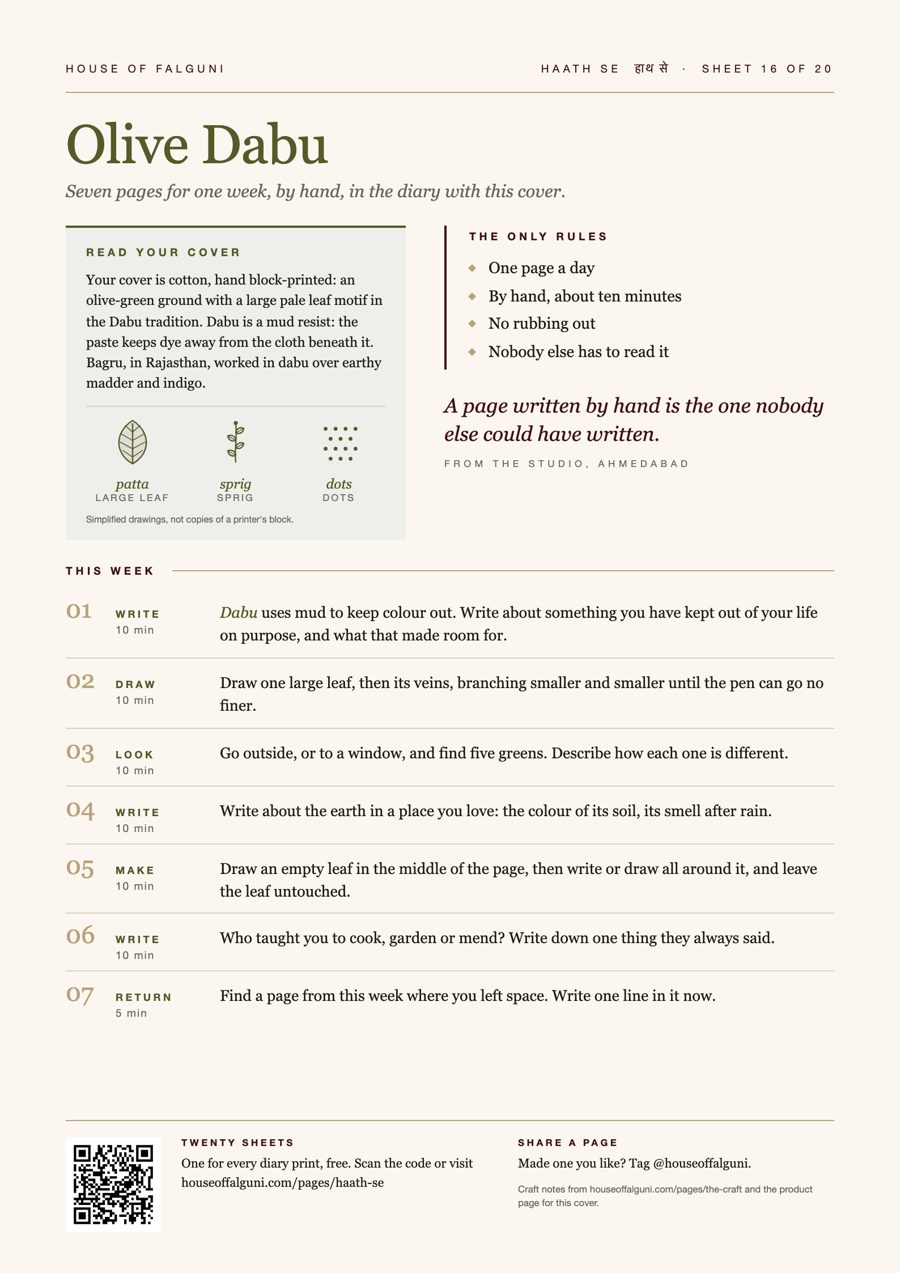
Haath Se prompt sheet 16, Olive Dabu: seven journaling prompts for the Olive Dabu block print diary

Sheet 16

Olive Dabu

Your cover is cotton, hand block-printed: an olive-green ground with a large pale leaf motif in the Dabu tradition. Dabu is a mud resist: the paste keeps dye away from the cloth beneath it. Bagru, in Rajasthan, worked in dabu over earthy madder and indigo.

Read the seven prompts
  1. Write10 minDabu uses mud to keep colour out. Write about something you have kept out of your life on purpose, and what that made room for.
  2. Draw10 minDraw one large leaf, then its veins, branching smaller and smaller until the pen can go no finer.
  3. Look10 minGo outside, or to a window, and find five greens. Describe how each one is different.
  4. Write10 minWrite about the earth in a place you love: the colour of its soil, its smell after rain.
  5. Make10 minDraw an empty leaf in the middle of the page, then write or draw all around it, and leave the leaf untouched.
  6. Write10 minWho taught you to cook, garden or mend? Write down one thing they always said.
  7. Return5 minFind a page from this week where you left space. Write one line in it now.
Print this sheet (PDF)Print this sheetSee the Olive Dabu diary
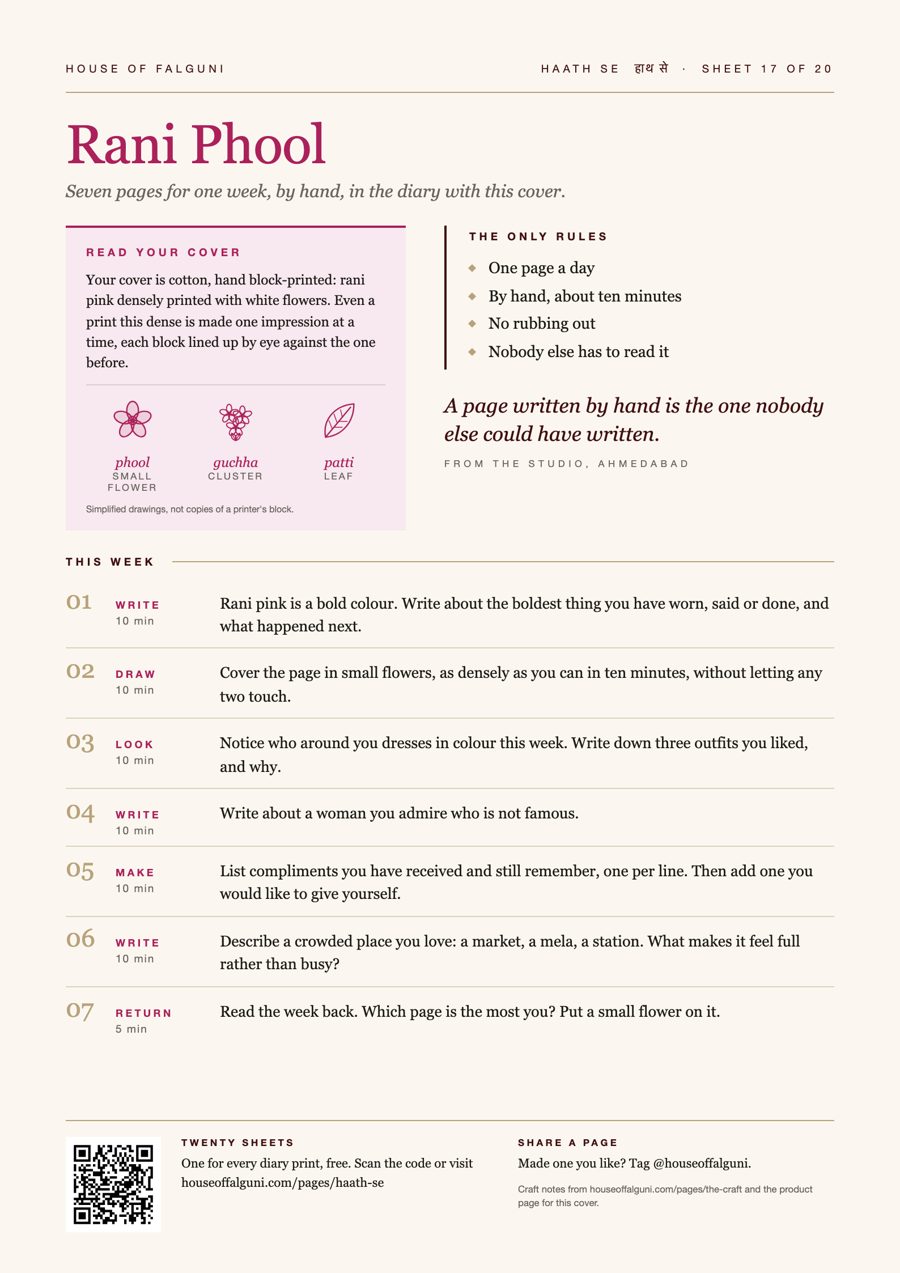
Haath Se prompt sheet 17, Rani Phool: seven journaling prompts for the Rani Phool block print diary

Sheet 17

Rani Phool

Your cover is cotton, hand block-printed: rani pink densely printed with white flowers. Even a print this dense is made one impression at a time, each block lined up by eye against the one before.

Read the seven prompts
  1. Write10 minRani pink is a bold colour. Write about the boldest thing you have worn, said or done, and what happened next.
  2. Draw10 minCover the page in small flowers, as densely as you can in ten minutes, without letting any two touch.
  3. Look10 minNotice who around you dresses in colour this week. Write down three outfits you liked, and why.
  4. Write10 minWrite about a woman you admire who is not famous.
  5. Make10 minList compliments you have received and still remember, one per line. Then add one you would like to give yourself.
  6. Write10 minDescribe a crowded place you love: a market, a mela, a station. What makes it feel full rather than busy?
  7. Return5 minRead the week back. Which page is the most you? Put a small flower on it.
Print this sheet (PDF)Print this sheetSee the Rani Phool diary
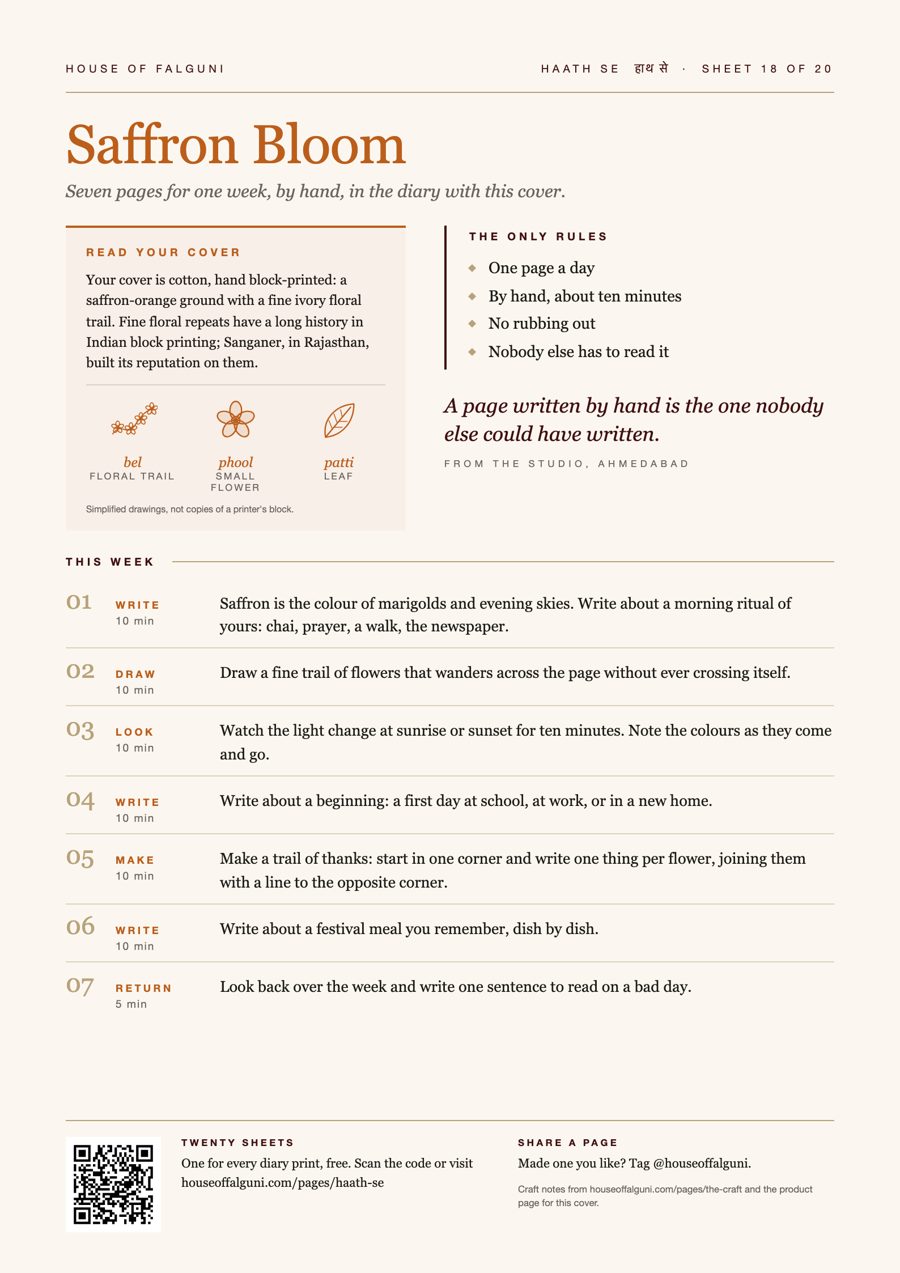
Haath Se prompt sheet 18, Saffron Bloom: seven journaling prompts for the Saffron Bloom block print diary

Sheet 18

Saffron Bloom

Your cover is cotton, hand block-printed: a saffron-orange ground with a fine ivory floral trail. Fine floral repeats have a long history in Indian block printing; Sanganer, in Rajasthan, built its reputation on them.

Read the seven prompts
  1. Write10 minSaffron is the colour of marigolds and evening skies. Write about a morning ritual of yours: chai, prayer, a walk, the newspaper.
  2. Draw10 minDraw a fine trail of flowers that wanders across the page without ever crossing itself.
  3. Look10 minWatch the light change at sunrise or sunset for ten minutes. Note the colours as they come and go.
  4. Write10 minWrite about a beginning: a first day at school, at work, or in a new home.
  5. Make10 minMake a trail of thanks: start in one corner and write one thing per flower, joining them with a line to the opposite corner.
  6. Write10 minWrite about a festival meal you remember, dish by dish.
  7. Return5 minLook back over the week and write one sentence to read on a bad day.
Print this sheet (PDF)Print this sheetSee the Saffron Bloom diary
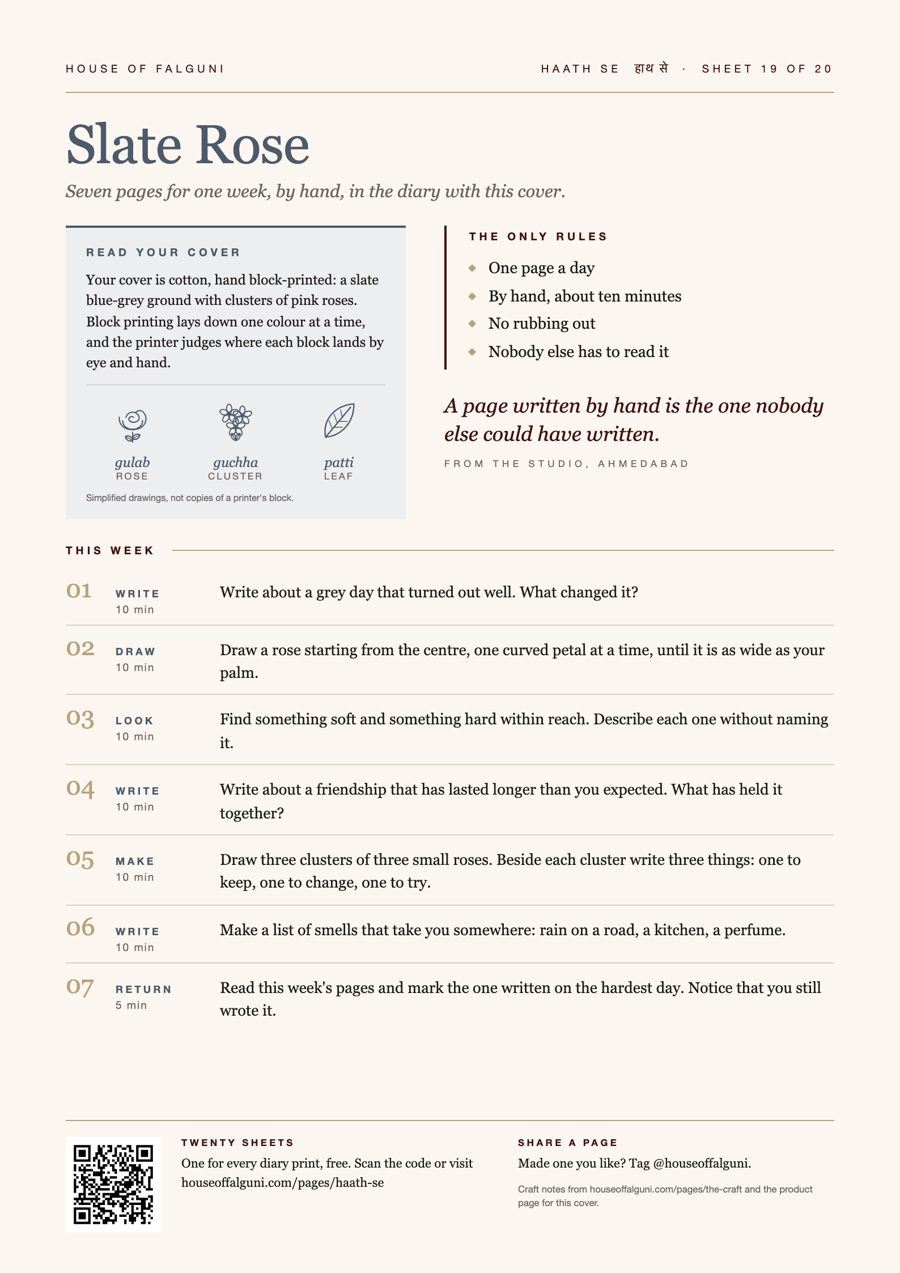
Haath Se prompt sheet 19, Slate Rose: seven journaling prompts for the Slate Rose block print diary

Sheet 19

Slate Rose

Your cover is cotton, hand block-printed: a slate blue-grey ground with clusters of pink roses. Block printing lays down one colour at a time, and the printer judges where each block lands by eye and hand.

Read the seven prompts
  1. Write10 minWrite about a grey day that turned out well. What changed it?
  2. Draw10 minDraw a rose starting from the centre, one curved petal at a time, until it is as wide as your palm.
  3. Look10 minFind something soft and something hard within reach. Describe each one without naming it.
  4. Write10 minWrite about a friendship that has lasted longer than you expected. What has held it together?
  5. Make10 minDraw three clusters of three small roses. Beside each cluster write three things: one to keep, one to change, one to try.
  6. Write10 minMake a list of smells that take you somewhere: rain on a road, a kitchen, a perfume.
  7. Return5 minRead this week's pages and mark the one written on the hardest day. Notice that you still wrote it.
Print this sheet (PDF)Print this sheetSee the Slate Rose diary
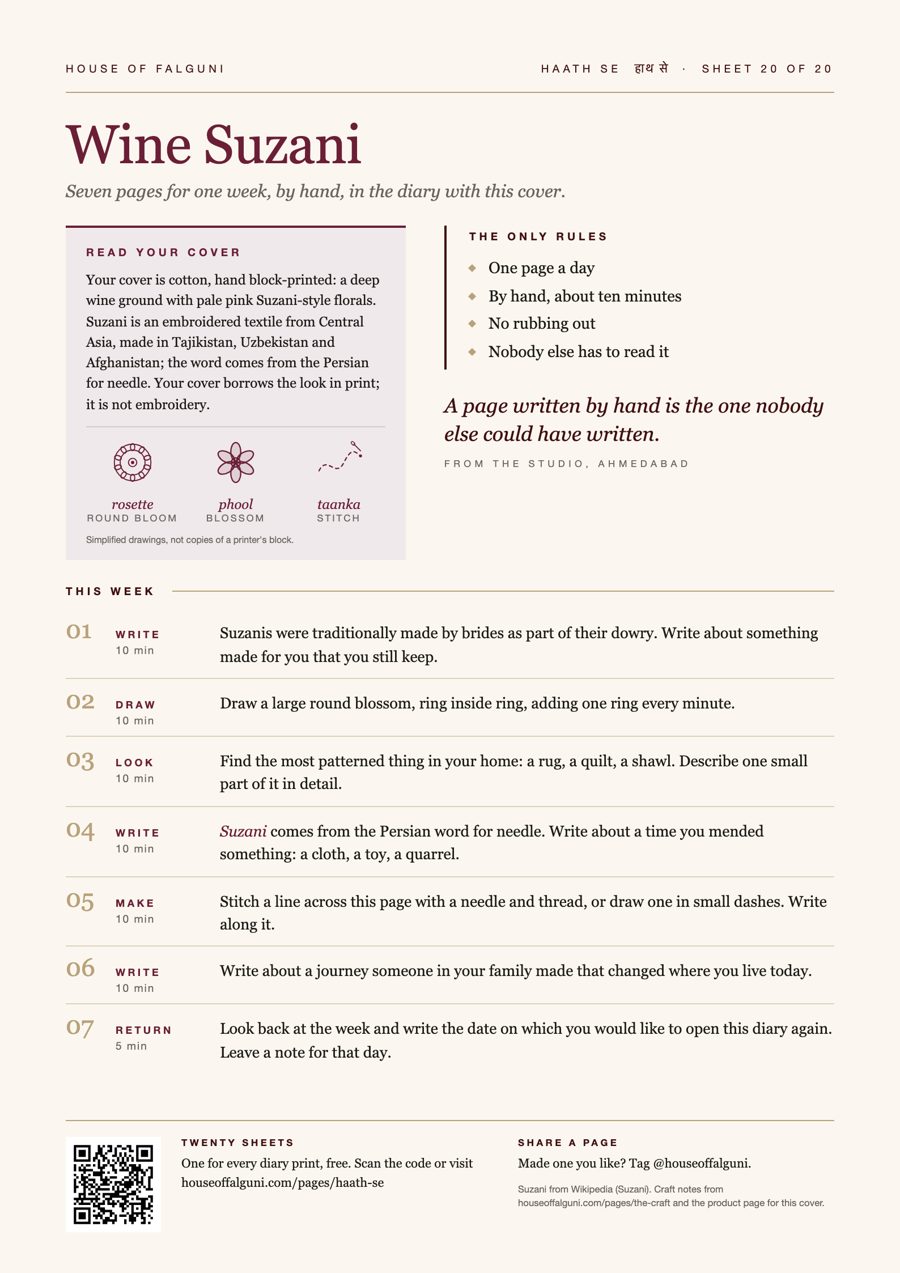
Haath Se prompt sheet 20, Wine Suzani: seven journaling prompts for the Wine Suzani block print diary

Sheet 20

Wine Suzani

Your cover is cotton, hand block-printed: a deep wine ground with pale pink Suzani-style florals. Suzani is an embroidered textile from Central Asia, made in Tajikistan, Uzbekistan and Afghanistan; the word comes from the Persian for needle. Your cover borrows the look in print; it is not embroidery.

Read the seven prompts
  1. Write10 minSuzanis were traditionally made by brides as part of their dowry. Write about something made for you that you still keep.
  2. Draw10 minDraw a large round blossom, ring inside ring, adding one ring every minute.
  3. Look10 minFind the most patterned thing in your home: a rug, a quilt, a shawl. Describe one small part of it in detail.
  4. Write10 minSuzani comes from the Persian word for needle. Write about a time you mended something: a cloth, a toy, a quarrel.
  5. Make10 minStitch a line across this page with a needle and thread, or draw one in small dashes. Write along it.
  6. Write10 minWrite about a journey someone in your family made that changed where you live today.
  7. Return5 minLook back at the week and write the date on which you would like to open this diary again. Leave a note for that day.
Print this sheet (PDF)Print this sheetSee the Wine Suzani diary

Questions

What is Haath Se?

Haath Se is a set of twenty free journaling prompt sheets from House of Falguni, one for each of our block print fabric diaries. Each sheet has seven prompts for one week, drawn from the motifs, colours and craft of one cover.

Do I need a House of Falguni diary to use them?

No. The prompts work in any notebook. They are written for our covers, so each sheet opens with a short note on its print, but every prompt stands on its own.

Are the sheets free?

Yes. All 140 prompts are free to read on this page. The printable PDFs are free too: we ask for your email before they open, and we write now and then about new prints. You can unsubscribe at any time.

How long does each prompt take?

Five to ten minutes. Each one is meant to fill a single 4.5 × 7 inch diary page, so one sheet is a week of short, daily pages.

What size do the sheets print at?

A4, one page per sheet. They print well on a home printer, in colour or in black and white.

Why write by hand?

Because it is slower, and slow is the point: you notice more, and you end up with a page nobody else could have made. This is not a case against screens. A diary is simply the one place we like to put them down.

Can I use them with a class or a group?

Yes. They are free for personal and classroom use. Please don't sell them or reprint them as your own.

How do I share a page I made?

Tag @houseoffalguni on Instagram. We would love to see the pages, crossings-out included.

Keep reading

Sources

  1. House of Falguni, The Craft: block print, Bagru, Sanganer and Ajrakh
  2. House of Falguni, Ajrakh Motifs: motif names and their written sources
  3. The product page for each diary, for the description of its cover
  4. Wikipedia: Shibori
  5. Wikipedia: Suzani (textile)
  6. Wikipedia: Madhubani art

Motif drawings on the sheets are simplified illustrations, not copies of any printer's block. Spotted something wrong? Write to the studio.