
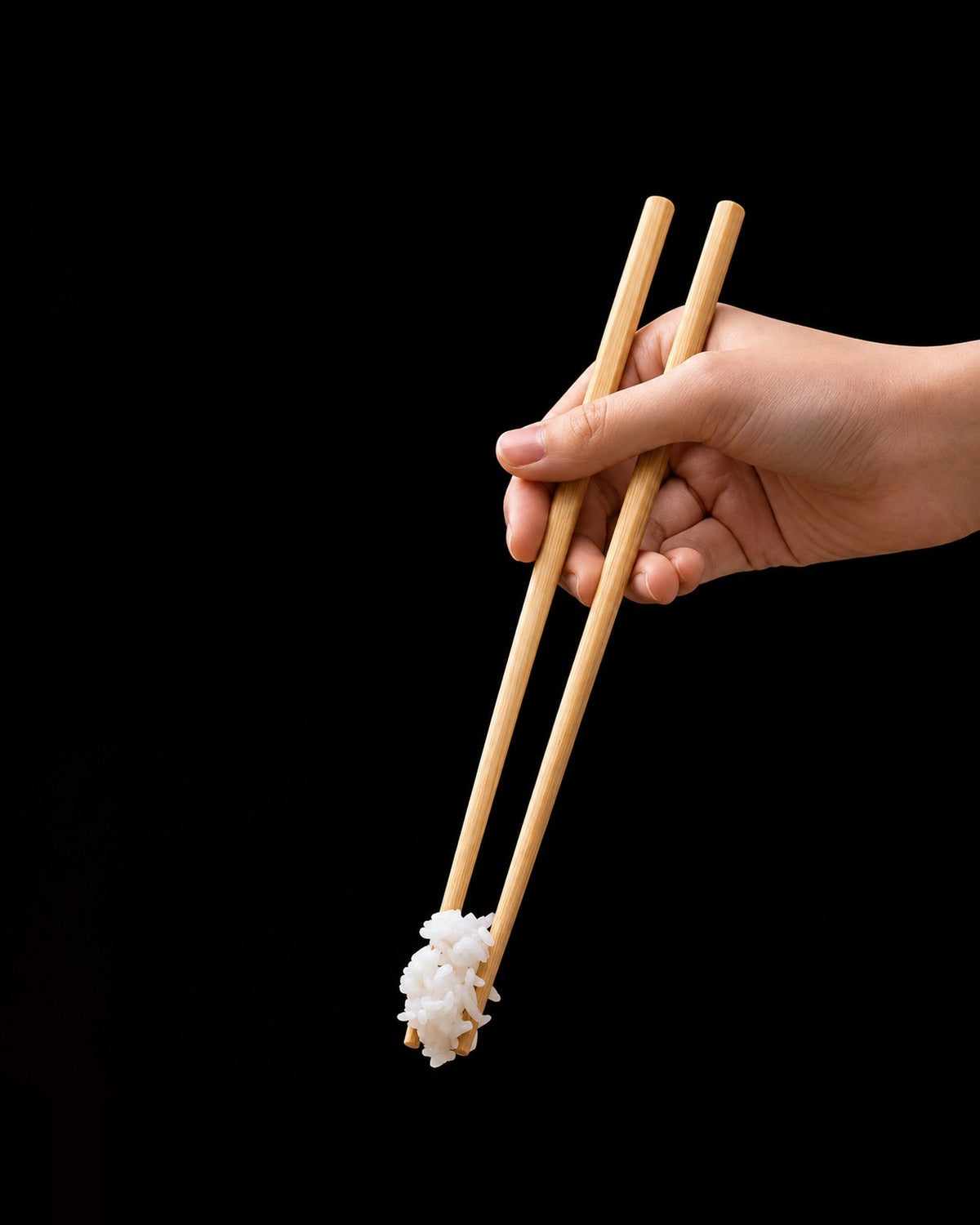
To use chopsticks, hold them about a third of the way down from the top. Rest the bottom stick in the web of your thumb and against your ring finger, where it stays still. Hold the top stick like a pen, between the tip of your thumb, your index finger and your middle finger. Line up the tips, then move only the top stick to open, close and lift.
That is the whole technique. What remains is practice, a sensible first pair and a few manners that matter more in some countries than others. In Indian cities, chopsticks usually arrive with a plate of noodles at an Asian restaurant, and that is a fair place to begin. How they reached that table is its own story: Chopsticks by the Hooghly. This guide covers the grip, the mistakes almost everyone makes, an Indian order of foods to practise on, and which pair to learn with.
How to hold chopsticks, step by step
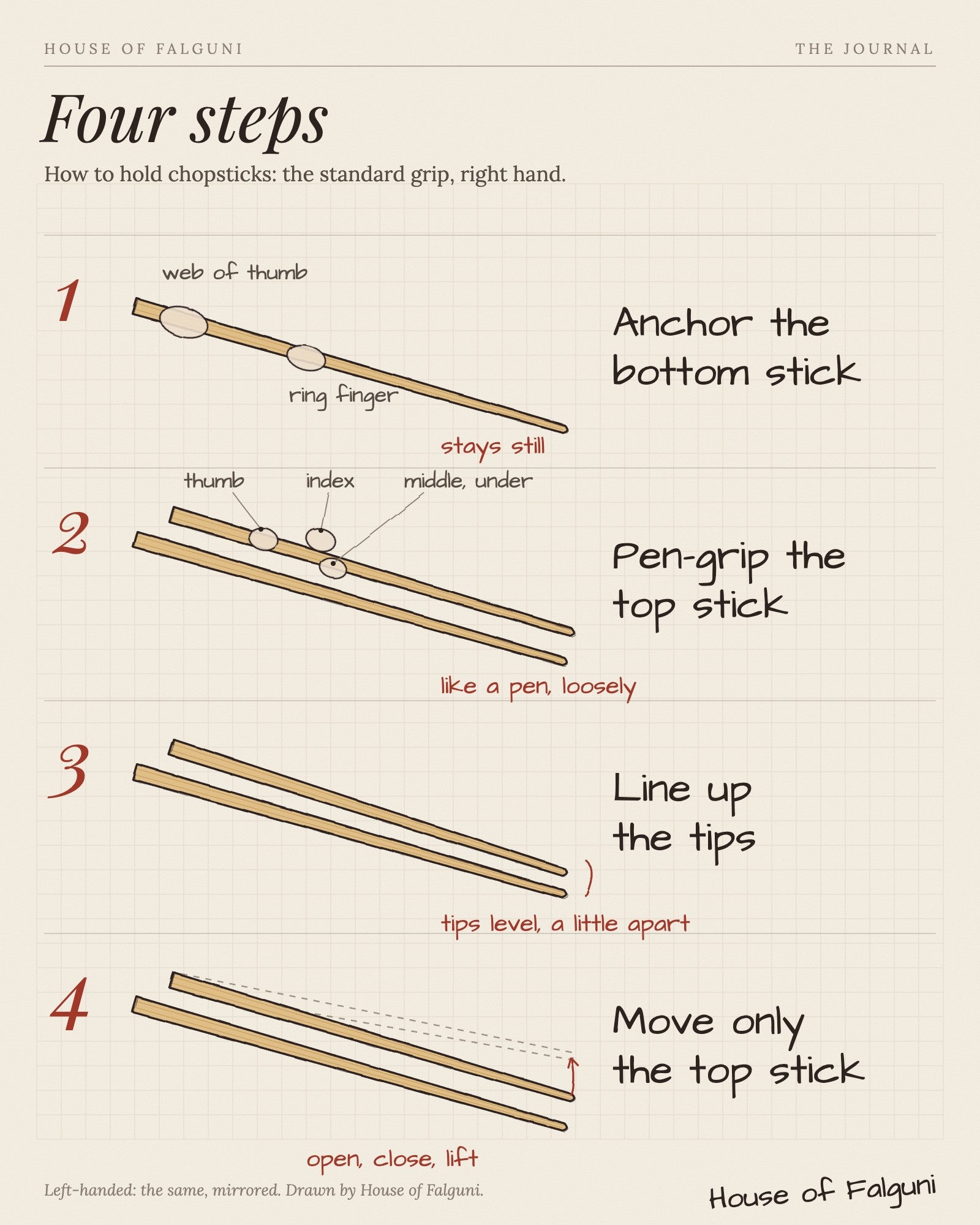
| Step | What to do | Check |
|---|---|---|
| 1. Anchor the bottom stick | Lay it in the web between thumb and index finger, resting on the side of the ring finger near the first knuckle. The base of the thumb presses it in place. | From here on it does not move. |
| 2. Pen-grip the top stick | Hold it the way you hold a pen: the tip of the thumb and the tip of the index finger on top, the middle finger underneath. | Loose enough to wiggle. A clenched hand cannot open the sticks. |
| 3. Line up the tips | Tap the tips lightly on the plate so they sit level, a little apart. | Uneven tips cross over each other and miss the food. |
| 4. Move only the top stick | The index and middle fingers lift and lower the top stick while the thumb steadies it. Open, close over the food, lift. | The tips meet like a pair of tongs with one arm fixed. |
The thumb does two jobs at once, which is why the grip feels odd at first. Its base pins the bottom stick against the ring finger, while its tip helps steer the top one, so it has to lie fairly flat rather than bend. The physicist Tsung-Dao Lee described the result neatly: chopsticks are an extension of human fingers, and whatever fingers can do, chopsticks can do too.
For slippery or soft pieces, such as a steamed dumpling or silken tofu, do not squeeze. Slide the tips underneath and lift the piece on top of them, the way a waiter carries a tray.
Three mistakes almost everyone makes
Moving both sticks. It feels natural to pinch with both, and it is the classic beginner's error. Two moving sticks never quite meet. Keep the bottom one still and let the top one do the work.
Gripping too hard. A clenched fist cannot open the tips wide enough, and the food tends to shoot across the table when the pressure slips. Hold the sticks the way you would hold a pen for a long letter, not a signature.
Holding too low. Fingers close to the tips give you less reach and more sauce on your knuckles, and the tops clatter together before the tips open. Move your hand up toward the top third of the sticks. The Leung family of The Woks of Life repeat a grandfather's story that holding chopsticks low means you will stay close to home and holding them high means you will travel far. Whether or not you believe it, high is easier.
A fourth habit, spearing, works on a chunk of paneer and fails on everything else. Noodles and rice simply slide off.
First foods to practise on: an Indian order
Start with large, dry pieces that will not slip, move to small dry ones for accuracy, and leave the slippery and the loose for last. A few minutes a day at the dining table does more than one long, frustrating restaurant meal.
| Order | Practise on | Why it works |
|---|---|---|
| 1. Large and dry | Paneer cubes, cut carrots, gobi florets | A big surface and no sauce. You learn the open and close without chasing the food. |
| 2. Small and dry | Roasted chana or peanuts, a few at a time | Builds accuracy at the tips. Hard and not oily, so a miss costs nothing. |
| 3. Soft and round | Steamed momos | Teaches you to lift from underneath instead of squeezing. |
| 4. Long and slippery | Hakka noodles | Lift a small bundle and bring the bowl a little closer. This is what chopsticks are used for across much of Asia. |
| 5. Last, or never | Rice | Short-grain sticky rice lifts in small clumps. Long-grain basmati falls apart, so keep a spoon for it. |
Noodles come before rice for a reason. In Thailand, Myanmar, Laos and Nepal, chopsticks are generally used only for noodles, and Indian families in Singapore and Malaysia reach for them mainly for noodle dishes too. Rice is another matter. An Indian writer on Substack put it honestly after years of trying: noodles now come with only minor damage to the shirt, sushi more easily, but rice, no. The essay's explanation is the right one. East Asian rice is short-grained and sticky, so the grains cling together, while basmati is made to stay separate.
Dal, rasam and curd stay with a spoon. So does a Korean table, which pairs every set of chopsticks with a spoon for rice and soup.
Bamboo, steel or wood: which pair to learn on
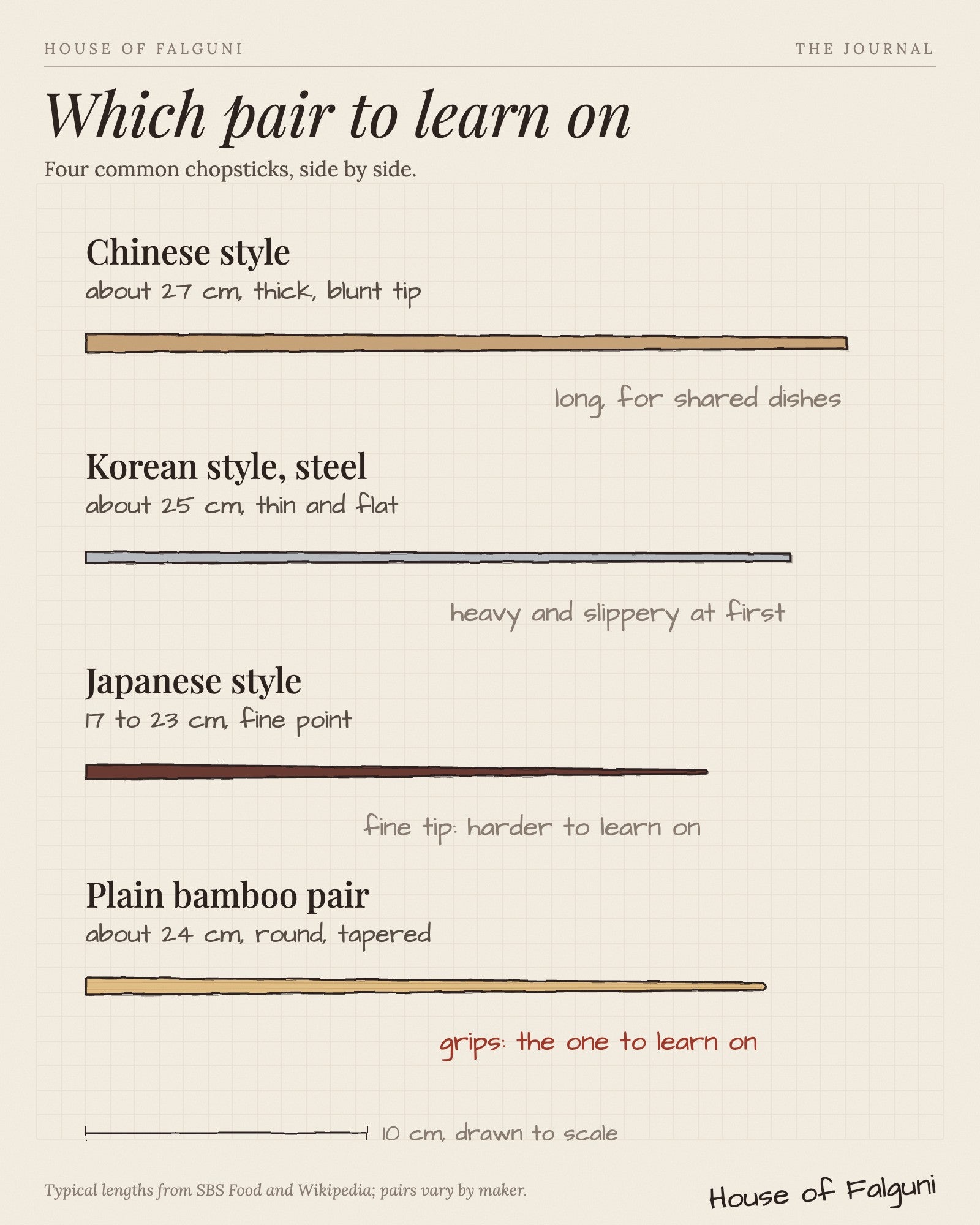
Learn on plain bamboo or unfinished wood. The surface has a little texture, so food stays between the tips and the sticks do not roll in your fingers. Bamboo and wood also carry little heat from a hot bowl to your hand; Split from a Grass follows the culm to the pair.
Steel is the hardest start. Korean-style steel chopsticks are thin, flat and heavy, and smooth metal lets both the food and the stick slip until your fingers know where to sit. Lacquered and plastic chopsticks are slippery in the same way. Steel pays you back once the grip is in your fingers: a round pair such as Sutra, about 9 in (23 cm), goes in the dishwasher, holds no water, oil or smell, and will not splinter or warp. Japanese-style chopsticks are shorter, between about 17 and 23 cm, and taper to a fine point that suits fish and small pieces but leaves a beginner very little to grip. Chinese-style chopsticks run longer, at about 27 cm, with blunt tips, long enough, by most accounts, to reach shared dishes in the middle of the table.
Length matters less than people think. Most eating chopsticks are 23 to 26 cm. Our own pair, Bamboo Ritual, is plain natural bamboo about 9.5 inches (24 cm) long, round and tapering to the tip, sold as two pairs for ₹999. It is made in India by an artisan we work with and checked in our studio before it ships.
You do not need to buy anything to start. A free takeaway pair is a perfectly good trainer for the first week. A reusable pair earns its place once you are eating with chopsticks every week. The one limit with bamboo is washing: wash it by hand in warm, soapy water and let it dry completely before it goes in a drawer, because bamboo left in a dishwasher can take up the detergent, and a pair put away damp can grow mildew.
Chopstick manners worth knowing
Nobody at an Indian table will mind how you hold them. In China, Japan and Korea, a few habits carry real meaning, and in an Asian restaurant here they are an easy courtesy.
Do not stand them upright in rice. In China and Japan many people avoid it because it recalls incense sticks at a funeral offering.
Do not pass food from your chopsticks to someone else's. In Japan this echoes a cremation rite. Put the piece on their plate instead.
Do not point, drum, stab or suck on them. These are ordinary table manners in every chopstick-using country, and crossing them on the table is also avoided in China.
Lift the bowl, but know where. In China it is fine to bring the rice bowl to your mouth and push the rice in. In Korea and Japan it is considered rude.
When you stop eating, lay the pair side by side on a chopstick rest or across your plate or bowl. In a restaurant without rests, the paper sleeve folded into a small block does the job. At home, a divided sauce dish for soy sauce and chilli oil and a small serving bowl for each person keep the table easy to reach across. For the rest of an evening with friends round the table, see our guide to hosting a dinner party at home, and for the pieces we keep for it, our table accents.
Frequently asked questions
What are the 7 rules for using chopsticks? There is no official list of seven, but most guides agree on these: hold them near the top rather than the tips, move only the top stick, never leave them standing in rice, do not pass food from one pair to another, do not point, drum or spear with them, do not cross them on the table, and rest them side by side when you stop.
What do you do with chopsticks after eating? Lay them together, tips level, on a rest or over the rim of your plate or bowl. If there is no rest, fold the paper sleeve into one. Never leave them standing in the bowl.
Are there different types of chopsticks? Yes. Chinese chopsticks are the longest of the three, around 27 cm, and blunt; Korean ones are usually flat steel, about 25 cm, and come with a spoon; Japanese ones are shorter, 17 to 23 cm, and finely pointed; Vietnamese ones are long and blunt. Most eating chopsticks fall between 23 and 26 cm.
Is it better to have metal or wooden chopsticks? Wood or bamboo is better to learn on because it grips food and stays put in the hand, and it carries little heat. Metal is easy to clean and can go in a dishwasher, but it is heavier and slippery for beginners. Bamboo needs washing by hand and drying fully. Once you eat with chopsticks every week, a steel pair lasts for years, and since it takes in no water, it will not grow mould in a damp drawer.
How do you eat rice with chopsticks? Lift small clumps of sticky, short-grain rice, bringing the bowl a little closer if you are eating Chinese-style. Long-grain basmati does not hold together, so a spoon is the honest answer.
How long does it take to learn to use chopsticks? With a few minutes of practice a day, most people feel the movement become smooth within a few weeks. Start on large, dry pieces and leave rice for last.


